
The great utility of bathing, as regards the establishment and preservation of sound bodily health, is sufficiently acknowledged all over the world to render any comments of ours on the subject necessary. Our immediate object is to suggest the erection of a few bathing houses on the bank of our beautiful river; for we feel assured that an undertaking of the kind would not only be attended with present profit to the proprietor but be the means of supplying one of the greatest wants of the townspeople, many of whom have expressed their willingness to contribute liberally for such accommodation.
Moreton Bay Courier
For a moment there, as I read the first sentence, I thought that perhaps all of the dreadful things I’d heard about 19th century hygiene were untrue. Perhaps they bathed more often than received wisdom would suggest.
The second sentence put paid to that idea, and led me down a rabbit-hole of 19 century bathing-machines, bathhouses and the means and nature of public swimming and bathing in old Brisbane.
In the 19th century, taking a cooling dip in a bathhouse at the river would have less to do with cleaning oneself with soap and water, and more to do with the preservation of health. It avoided the effort required and exposure involved in swimming. It wasn’t considered to be a luxury, or treating oneself. It had utility – it refreshed the person, in order that the person could be useful to society in business or family pursuits.
In some cases, people were described as bathing in the river when they were clearly taking a recreational swim. In others, they were just immersing themselves briefly to cool down. A few were actually attempting ablutions in the river.
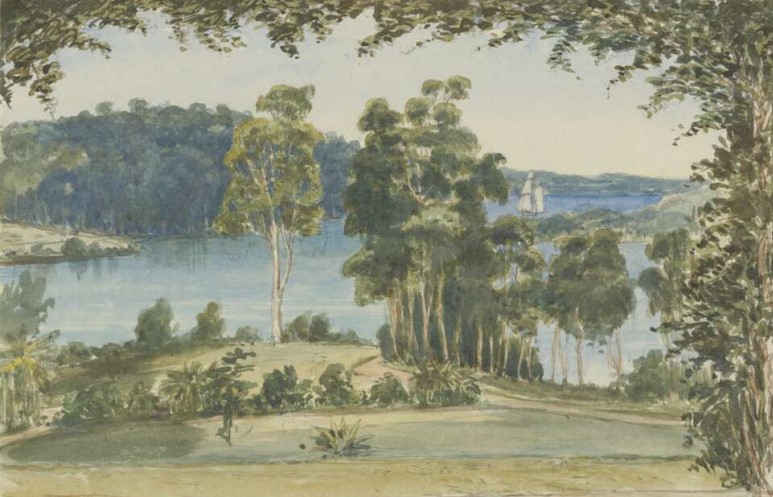
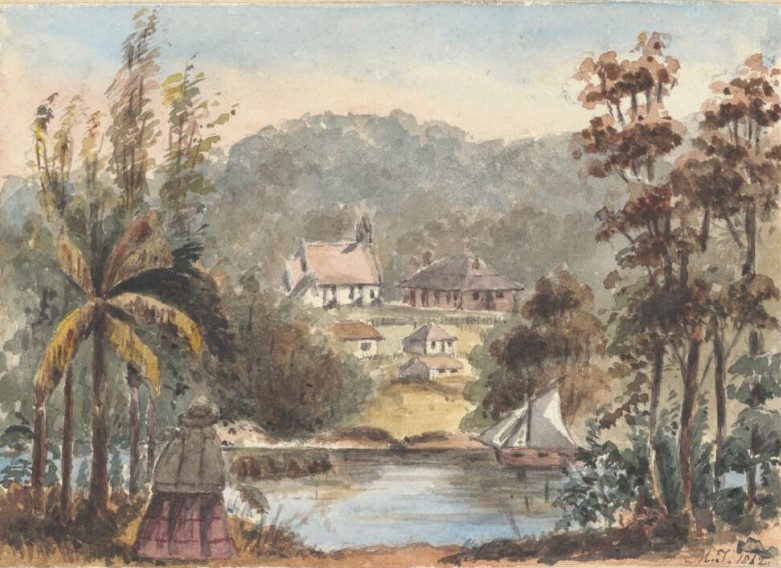
From contemporary paintings of 19th century Brisbane, the river was a sparking blue colour, which it may well have been before 20th century dredging works. It would have been tempting to put a bathhouse on these banks for purification of body and spirit. One could certainly not imagine wanting to “bathe” in any sense of the word, in the brown waters of today’s Brisbane.
A Bathing House
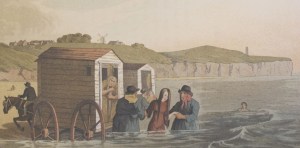
Trying to picture the kind of bathing house the Courier had in mind was difficult. The description doesn’t quite suggest the bathing machines of the period. Those were more suited to shallow sea-bathing and required wheels and horses. Traditional bathhouses were based on the Roman model, large indoor establishments, expensive to build and hardly necessary for a dip in the Brisbane river.
Then there were the proprieties of the time to consider. One couldn’t just saunter up in a bathing costume and take a quick dip. Mixed bathing would be an outrage. One had to change clothes. Twice. One wanted to enjoy the cool waters without attracting the leering attention of non-subscribers on the banks. Indeed, one wished to survive the experience (swimming in the river had been banned, due to shark attacks).

We have obtained, from Mr. Andrew Petrie, plans of a floating bath, which could be moored at any part of the river, and removed from time to time to different parts of the town, as might be required. Mr. Petrie has also made an estimate of the probable expense. The plan comprises two separate baths, with eight dressing-rooms, and other requisite arrangements.
Moreton Bay Courier
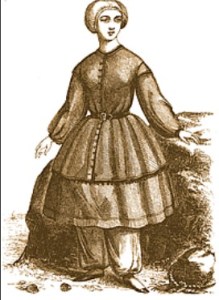
Brisbane did get its bathing house, in March 1848. They did not have to rely on the Colonial Architect and His Excellency in Sydney for permission, but were slightly limited by the amount subscribed. The more expensive floating one recommended by Andrew Petrie couldn’t be afforded, but a fixed one in the “pleasant, retired” riverbank near the Government Gardens. Admission was strictly for key-holding subscribers, and there were carefully drawn-up rules and regulations relating to its use (for the “comfort” of subscribers).
For those who could not afford to subscribe, the options for swimming and bathing outdoors required a sense of adventure, and a disdain for the law. Few homes had baths, and the idea of a public swimming pool, open to all genders and classes, would have boggled the imagination of a Moreton Bay colonist in the 1840s.
You want to bathe where??
Old Brisbane had creeks and waterholes, as well as the shark-infested river. Only the river remains today, civic works over the centuries having taken care of the water-holes. They reappear, after a fashion, during floods.
The Creeks

Gerler’s 1844 map of Brisbane Town shows two creeks meandering through the centre of town. One flowed from Spring Hill, along the future Roma Street, and down behind the Convict Barracks, crossing Queen Street at Creek Street. The other forked into two streams near the Catholic Church.
Small footbridges are shown on the map, allowing residents to traverse the town without too much inconvenience. The footbridge that crossed the creek at Queen Street became a favoured spot for local mashers to lounge about, making fraught the passage of ladies in crinolines.
The creek was deceptively benign-looking, but was in fact deep in places, muddy in others, and hazardous to cross except by the footbridge. Walter Petrie, son of Andrew and brother to John and Tom, was last seen on his way home from the river on the evening of April 25, 1848. When he did not return, his family searched all over the town, but didn’t check the insignificant-looking creek quite close to their home. A passer-by found Walter two days later, face-up in the creek. He had drowned after apparently slipping over while trying to cross the creek in the dark.

The muddy creeks were not conducive to swimming, nor recreational bathing of the sort envisaged by the Courier. As drainage and town works removed the creek, a small lagoon remained in Creek Street, at the corner of Elizabeth Street. Archibald Meston fondly recalled that the young boys of Brisbane enjoyed swimming and bathing in that “bogie hole” in the 1860s. Presumably the water there was clearer than the old creek, or there would have been a lot of very muddy youths about. The lagoon was eventually drained, and an impressive Moreton Bay fig tree (now National Trust listed) was planted in 1889.
The River
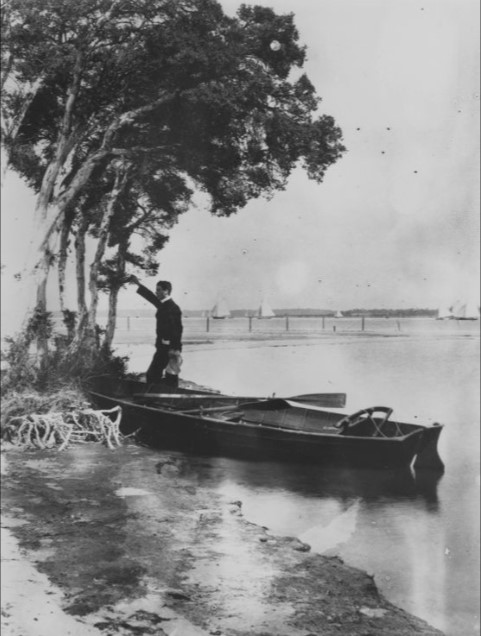
SHARKS.-On Wednesday, several very large sharks were seen in the river, near the Steam Navigation Company’s Stores; one of these monsters, upwards of fourteen feet in length, was observed in pursuit of two immense stinging rays, which, in their violent efforts to escape, threw themselves high and dry on the bank of the river, where they were captured. Persons bathing should be extremely cautious in venturing far from the side, particularly when others are not present to render assistance in case of accident.
Moreton Bay Courier
Fortunately the sharks that prowled the river gradually retreated as the population grew, and vessels traversed it regularly.
For the very poor, the creek, river or waterhole offered a chance to get the grime and sweat off the body. And for all the prudery of Victorian times, it would seem that swimming and bathing in the river was often conducted in the nude (by men, generally).
In the generality of cases, however, no attention is paid to decency, and the residents on the river bank are often subjected to much annoyance. Perhaps the evil will never be removed until large public baths are erected.
Brisbane Courier
Still others bathed in horse-ponds in a state of nature:
A HALF-CASTE lad named James Davis, who has been living in Burnett-lane, is missing from his home. He was last soon on Saturday evening, bathing in the horse-pond opposite Kent’s Bazaar, Albert-street. It is not supposed that he was drowned, otherwise probably his clothes would have been found.
Brisbane Courier
The James Davis in question was the natural son of James “Duramboi” Davis, and had been living with his father (and his father’s European wife) in their Burnett Lane house. He did get home, presumably clothed, and was still there to witness a spectacular Davis family barney six years later.
If the river, a bogie hole or a horse pond didn’t strike your fancy, there were other options.
The Reservoir
There was the Reservoir, established as the town’s water supply after the convict era. It lurked, its contents noisome and grainy, in the area behind today’s Roma Street station. Bathing in the Reservoir was discouraged – whether this was to protect the water supply from the dirt of bathers, or the bathers from the dirt of the water supply, is debatable.

“It has lately been brought under our notice that some of the boys residing in the town are in the habit of bathing in the reservoir. If such conduct is tolerated by the parents of those children, they have cause to be ashamed of themselves. One of the most important requisites to the health of the people, in a warm climate like this, is a plentiful supply of pure water; and any person who countenances the pollution of the only source from which we can obtain it, is an enemy to society.
“We can state that positive instructions have been given for the apprehension of any person, young or old, who may be found bathing in the reservoir in future; and if any such offenders are brought before the Magistrates, it will be only just to make a severe example of them.” Moreton Bay Courier
An enemy to society! Imagine how people felt about thieves or murderers. The best description of the Reservoir comes from Thomas Roper, an immigrant by the Fortitude, who saw it in its glory days.
“The town was supplied with water for domestic purposes from this. There was no enclosure of any kind or any convenience of raising water. The waterman simply backed their drays into the water and with rope and bucket filled their casks usually three for a load and sold at 9d. per cask.
“What is lost in transparent purity was compensated by being both food and water, more especially after thunder storms. This was a favourite resort for dogs to get a luxurious bath.”
At Home

Ordinary daily washing usually involved a pitcher of water, some soap and a cloth and involved a quick wash of the hands, face, armpits and privates. This option was open to pretty much everyone, and kept the population reasonably clean.
Taking a proper bath at home presented some logistical difficulties. Water was not piped into the house, and most relied on the water from the Reservoir, a private well, or a tank, if they were very lucky. If a household had a bathtub, it needed to be filled with buckets of hot water from the stove. Water was not to be wasted, so the bathwater was used by all family members in succession. Pity the poor person who came last, and endured the cold, grotty water left behind by the others.
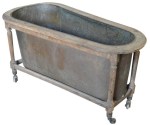
Bathtubs often had wheels, so that they could be put away easily after use (bathing would generally take place in the kitchen, where water could be heated easily). Families with servants could bathe in the privacy of their bedrooms, employing maids to lug the hot water to the tub.
A quick look through the shipping arrivals show that Mr Power and Mr Rolleston were early local adopters of the home bath, having their bathtubs shipped up from Sydney per the Tamar. The first advertisement involving home baths in Queensland newspapers appears in 1850, with a Mr W Taylor (late of Messrs Jeaques’s Kitchen-Fitter to Her Majesty, mind you) offering repairs to hot-water baths & c.
The Great Unwashed
The poor, who couldn’t always afford the 9d. for a cask of delicious, fresh reservoir water, might occasionally have been stinking. Particularly after a long, hot night in the watchhouse after a long, hard night on the town. Brisbane’s Police Magistrate had to resort to trying to block the effects of the unbathed humanity that appeared before him, unkempt and generally contrite.

Mr. Pinnock had a large palm leaf fan and bottle of eau de cologne. No doubt the atmosphere of the Police Court, then in Elizabeth Street, was very “thick” at times, and the butcher’s yard at the back did not improve matters, especially in summer.
Victor Drury, The Courts and Legal Luminaries
Perhaps mindful of this, one notorious offender freshened herself off completely prior to her appearance in Court. Do you think the Police Magistrate was pleased or relieved? Not at all.
“On Friday morning last a lady of mature years and considerable avoirdupois caused a sensation at North Quay by disporting in the river entirely in the nude. As already reported, the lady gave the police a considerable amount of trouble, when they endeavoured to save her, one of their number being given an involuntary bath. When hauled ashore she refused to dress or be dressed, in fact, she settled that part of the transition to her own satisfaction by tearing her apparel to shreds. The usual big crowd had assembled, and the police made the best of a bad job by hauling their capture to the watchhouse in a cab-but still In the nude.“
Mary Maher was the terror of the police courts in the early 1920s, racking up over 300 convictions for her drinking habits, and the consequences of same. She tended to bathe daily in the river, but usually went in fully clothed, killing two birds with one stone by completing her laundry and her ablutions at the same time. Mary was not a person of fixed abode, but she tried to keep herself as clean as possible.
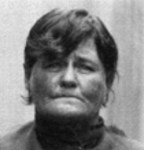
The problem of her nakedness taxed the watchhouse keepers, and threatened to delay her appearance in Court the following morning. She solved the problem by wrapping herself in a rug and elbowing her way past blushing policemen to state her defense in “pungent” terms. The police magistrate, unappreciative of the lengths Mary had gone to in order to appear before him in a state of cleanliness, couldn’t get rid of her quickly enough. She got three months, and, true to form, added to that time by repeatedly breaching prison rules. What a gal. Perhaps in her youth, she had read an article like this, and decided that she would always repair to bathing regularly in some shape or other, as the author recommended:


 Moreton Bay and More
Hi ‘Moreton Bay and More’ (I couldn’t find your real name anywhere)
The ‘bathing houses’ were built in the the river between around 1860 and 1890–there were several of them, between Grey Street and the future Story Bridge. They were large roofed structures (possibly around the size of the extant Spring Hill Baths) I’d attach a map and photos, but this reply doesn’t have that function)
The old reservoir was on the present law courts site, rather than “in the area behind today’s Roma Street station” (again, I can’t attach maps here to show you, sorry)
Regards
LikeLike
Hi Peter, thank you very much for that information – I admit that trying to picture the bathing houses exhausted my imagination! And I will correct my info on the old reservoir – by the way, was it on the site of the Supreme and District Courts, or the Magistrates Courts? Thank you!
LikeLike
Hi Karen
The reservoir was on the site of both the present Supreme and Magistrates’ Courts buildings–the dam wall was around 30 m wide and about where the western wall of the Magistrates’ building is now, with the body of water tapering to around where the Transcontinental Hotel is now
Some other sources say the reservoir was on the site of the Roma Street station (or even the future City Hall site), but contemporaneous maps definitely show it on the present law courts site
LikeLike
Hi Karen
The reservoir dam wall was roughly where the north-western wall of the Magistrates’ Court building is now – the dam wall was about 30 metres wide.
The reservoir itself was about 150 metres long, tapering to around Herschel Street
Some sources say the reservoir was on the site of the railway station (or the City Hall!), but this is not correct – see Ham’s map of Brisbane 1863 at the link below (the diagonal ‘New Street’ was later named ‘Roma Street’)
http://www.chapelhill.homeip.net/FamilyHistory/Photos/Brisbane_North_Quay/index.php?image=Brisbane1863-Hams.jpg&originalimage=true&d=d.html
LikeLike
Hi Karen
Map of public bathing houses around the town in the 1860s – threepence for a bath, sixpence for a bath and supplied towel
Photo 1 – South Brisbane
Photo 2 – Petrie Bight
Most were washed away in the 1893 floods
Regards
PEter
[image: image.png]
[image: image.png]
[image: image.png]
LikeLike
PS: My email address is peter.eedy at gmail dot com–I can send some maps and photos to you if you are interested
PPS: Great site you have here!
LikeLike
Thank you Peter. It’s lovely to receive your compliments!
LikeLike
You’re welcome, Karen!
Would you like the maps and photos I mention above? Send me an email if you do, as WordPress won’t let me attach here
LikeLike
I’ve been surfing on-line greater than 3 hours as of late, yet I never discovered any fascinating article like yours. It’s lovely value enough for me. In my opinion, if all web owners and bloggers made excellent content as you did, the internet will be a lot more useful than ever before.
LikeLike