

It’s quite comforting to look back on old Brisbane and find that many of the hazards of life these days also troubled our forebears. The river still has its surprises for the unwary. Pet ownership attracts all manner of official scrutiny, not to mention revenue-raising. Traffic is still appalling and drunks still populate our watchhouses. Bits and pieces of old Brisbane turn up today in construction works, but not as alarmingly as they did at the end of the convict era.
Fortunately, the ferry service has improved, despite the setbacks from the floods, and goats are no longer able to take up residence on any verandah that takes their fancy.
The River
These days, there are bridges for pedestrians, bridges for vehicles, tunnels, ferries, Citycats, pleasure-craft and helipads for river commuting. The Lord Mayor has suggested that by some unspecified means, it might be possible to make the river look less, well, brown in the future. Rowing clubs train on it, but only rarely does anyone swim in it. At least not while sober, and generally not intentionally.
In the 1840s, a bridge was a distant prospect, and the ferry service was, well, let’s get the Courier’s view:
“If we knew a friend whose temper required softening, we would recommend him to try a course of ferrying between North and South Brisbane. Some profane person said that Job had never lost a barrel of ale through leaving the tap out: with all reverence, we feel convinced that Job never had to hail the ferry-boat after nightfall. Seriously, it is the greatest exercise of patience that any person could experience. From South Brisbane you may sometimes be ferried across without much delay, but from the North side scarcely ever. The explanation is simple enough. The ferrymen live on the South side.”
The ferry was the only way of crossing the river for those whose budgets did not extend to owning a boat, thus the proprietors were able to make a tidy profit from commuters who must have bemoaned the lack of choice. The Courier suggested that some of the hundreds of pounds of profit the ferries made could be used in “forming at least a bark hut on the North side, as a station for one of their men.”

The Brisbane River in the 1840s. Predatory creatures of the deep not pictured.
The ferry service was so poor that it may have been tempting to attempt a quick swim. After all, we were a fair way from the ocean – who would imagine encountering a shark? The Courier reported a spectacular sight in November 1847:
“On Wednesday, several very large sharks were seen in the river, near the Steam Navigation Company’s Stores; one of these monsters, upwards of fourteen feet in length, was observed in pursuit of two immense stinging rays, which, in their violent efforts to escape, threw themselves high and dry on the bank of the river, where they were captured.”
The following week, Mr Robertson, a teacher, and Mr Stewart, a company manager, decided that the river was an ideal spot for a refreshing bath. Off came their garments, and Mr Stewart ventured into the water. Mr Robertson – perhaps a subscriber to the Courier – held back, concerned that something untoward would happen. Sure enough, a large shark was soon pursuing Mr Stewart, who received some serious injuries to his legs. He was hospitalised, and reported to be getting on “favourably,” despite losing a lot of blood. “It is not a little singular that the fears expressed in a late number of this journal respecting the safety of persons bathing in the river, should so soon have been confirmed by such a terrible example,” mused the Courier.
The sharks that inhabit the Brisbane River are bull sharks. They can tolerate fresh water, and find river-dwelling fish quite a treat. Dog-owners are advised not to allow their furry friends to swim in the river, however tempting it might seem on a steamy day.
Livestock and Pets Everywhere
In 1847, the Chief Constable decided that the inhabitants of Brisbane Town were not contributing enough to the public purse, and placed flyers in lots of apparently dark, unvisited places, advising of a forthcoming dog registration program. Naturally, just about everyone failed to register their dogs, and found themselves before the Bench, expected to cough up the required shillings plus costs.
It turned out that more people would have been summoned but the Chief Constable ran out of official stationery. Still, a parade of Brisbane’s old residents faced the Court – Dr Ballow, Mrs Bailey, John Connolly, John Campbell, G.S. Tucker and Daniel Skyring included. Some defendants complained that their fidos were already chained – why did they need to pay a fee? Others denied having a dog at all. One tried to argue that his dog was a mere pup – a fine pup – but only a pup. Why should he register a little pup? The Bench was not moved.
Mr R.J. Smith decided that attack was the best defence. If he had to be fined for not registering a dog, why did the law not turn on Constable Murphy, who had a goat and several pigs that were known to wander the streets of Kangaroo Point? Why was one part of the law enforced but not the other, he asked? The Bench was not moved.

Constable Murphy at Kangaroo Point got away with letting his goats and pigs wander about, but people in South Brisbane were not so lucky. Mr Orr, a resident of that suburb, brought three of his neighbours to Court for “suffering goats to stray about the public streets.” Mr Orr was distressed at the goats’ habit of making use of his nice verandah on rainy days, not to mention the appearance of a very large Billy goat, who decided to challenge him for ownership of the property by rushing at him and head-butting. The goat-owners were fined five shillings each.
The Chief Constable, always anxious to impose fines, threatened a crackdown on public goats, but it appears that Constable Murphy’s livestock could still safely graze wherever they wished.
Traffic chaos
Today, a commute to the city tests the better instincts of any resident optimistic enough to brave the diversions, delays, potholes and changing speed zones in the hope of driving to work. History shows that Old Brisbane Town had terrible traffic problems long before the invention of the horseless carriage.
Speeding
Even in the colonial period, there were hoons (recklessly speeding drivers to non-Australians) to contend with on our few roads.

Mr Macintyre and Mrs Bailey decided to test their steeds to the limit through the streets of North Brisbane one fine July morning in 1847, coming dangerously close to running over some children who were playing in the street (a Mr Sloan came to the rescue of the little ones). There were about five streets in North Brisbane at the time, and the couple flew down most of them at full tilt. The Chief Constable summonsed them for furious riding, but neither party appeared to answer for their crime. Each was fined £5 in absentia, a fortune at the time. The Moreton Bay Courier approved:
“We have no doubt that others who think proper to indulge in freaks of this kind will be mulcted to the same extent, as the Magistrates are determined to put down such dangerous practices.”
Mrs Bailey, who no doubt indulged in a few other freaks, avoided Court because she famously did not keep company with Mr Bailey, if indeed he existed. She chose to spend her time with other gentlemen. Brisbane’s only demimondaine had long exhausted the possibilities of the 99th Regiment, and was now keeping company with the landed gentry. Mrs Bailey left town not long afterwards, following a ruckus created by members of the 99th Regiment, who protested rather too publicly at their exclusion from her parlour. Two scandals in such a small town was too much to bear, so she auctioned her elegant furniture and the contents of her fine cellar and departed for parts unknown. Probably Sydney. It was rumoured that she married a wealthy and respectable settler in New South Wales, and managed to keep her past a deep secret.
Accidents
George Whitting, a bullock-driver who had come out by the Mountstuart Elphinstone, was accidentally run over by his entire team of bullocks. Needless to say, the poor man died of his injuries.
William Crabb, a livery stable owner, must have incurred the lasting wrath of the entire equine species at some point in his career. He had already been hospitalised for months for injuries to his leg inflicted by one of his horses, which had put an end to his stable-keeping. No sooner was the man discharged, and proceeding rather gingerly across a street, than a horse and cart ran over him. The animal had divested itself of its driver, and taken the cart with it for a merry spin when Mr Crabb hobbled into view. The result was more time in hospital, with the added pain of broken ribs.
J.C. Pearce* was also a victim of repeated equine abuse. He was thrown by his horse, breaking one arm and badly injuring the other. Dr Dorsey looked after him at Ipswich, after which Mr Pearce travelled to Brisbane in something called Campbell’s American Wagon. The horse and wagon parted company at Cowper’s Plains, injuring Mr Pearce once more. The horse made for the bush, and Mr Pearce endured a long walk to Brisbane Town to be patched up by Dr Ballow. Fortunately, his injuries were treatable.

Drink Driving
At least the drink-driving that took place in the 1840s did little damage to other people. The drunken riders usually bore the brunt of the injuries from unplanned visits to the ground.

A man of the name of Malvary, in the employ of the Messrs. M. and C. Mc Donald, having come to town to transact some business, sacrificed so far to the jolly god, that on mounting a pony, which he had previously received in exchange for a mare and foal, the animal bolted at full speed, and threw him with great violence against a stump, but fortunately no further injury occurred than a severe bruising.
Convicts
Convicts, once the sole reason for Moreton Bay’s European settlement, were still in evidence after free settlement in 1842. Some old stagers like Hannah Rigby returned from Sydney after their sentences expired. Some runaways found their way (or were coaxed) back after years on the run – like James Davis, David Bracewell and John Sterry Baker. Others had never left. They had tickets of leave permitting them to remain and work in the Moreton Bay settlement, and quite a few of them made life difficult for their masters, and amusing for court reporters, in their new careers.
Convict Servants
Thomas Pawsey, attached to the Barracks in 1847, decided to nick off and get really, really drunk in South Brisbane. At some point, he also got naked, and could offer no reasonable explanation for either condition when he sobered up and was brought before the Bench. Fourteen days of solitary confinement in the lock-up resulted.
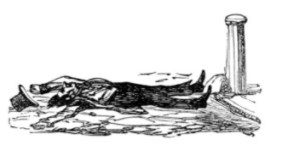
The following year, Pawsey was attached to the Hospital, and had been admitted as a patient there. Nevertheless, he managed to get out and once again get as drunk as possible. He remained in possession of his clothing on this occasion. Rather than send him all the way to Sydney for this indiscretion, the Magistrate put him in the cells at the Brisbane lock-up for a no doubt miserable weekend.
William Living and Francis Parker, who worked on the Pilot boat, went one better and got smashed at Kangaroo Point, and whilst in an intoxicated state, grossly insulted one Mrs Smith of Queen Street. They were sent to Sydney for two months’ hard labour, and had their tickets of leave cancelled.

Joseph Wright, who worked for Postmaster Slade, decided to outdo his colleagues by absenting himself, returning drunk and in the company of a “woman of bad character,” and then trying to steal two pineapples from Mr Slade’s garden. He only got two weeks in the local lock-up, but had his ticket of leave cancelled. Perhaps keeping company with a woman of bad character was less offensive to the law than insulting a woman of good character.
Convict Pirates
A few ticket-of-leave convicts disturbing the peace with their nudity, drunkenness and pineapple theft was trying for the more respectable citizens of the town. Nine desperate Norfolk Island escapees appearing in Moreton Bay in a piratically-seized launch was another matter entirely.
Joseph Cooper, John Meek, Denis Griffiths, James Merry, Thomas Claydon, Robert Mitchell, Joseph Davis, James Clegg, and John Sellifant aka Edward Sullivan had all been transported to Van Diemen’s Land, where they demonstrated that they had successfully avoided reform and were rewarded with a stay at the penal settlement of last resort, Norfolk Island.
On 11 March 1853, the group seized a loading boat and headed out for open water, and possible freedom. Nearly two weeks later, they washed up at Stradbroke Island in a heavy surf.

From there, the group split up. Some set about robbing a fisherman named Fernando, others were captured by Timothy Duffy and his indigenous fishermen, and the rest located the Harbour Master’s dwelling, robbed it, and stole the clothes from the backs of the Harbour Master’s crew. They thoughtfully left their old and no doubt smelly old convict gear behind for the crew to wear.
With just about every boat-owner in Brisbane in manful pursuit, it was not long before the various pirates were apprehended and brought into a shocked Brisbane Town. From there, it was a heavily supervised, depressing voyage back to Van Diemen’s Land.
Dead Convicts
One could be laying the foundations of one’s new home, only to find a skeleton in leg irons. Well, it happened once, to the baker Mr Savary, in 1846. The Courier conjectured that the deceased had been murdered by a fellow-convict and buried to prevent detection of the crime. It was a practice, it said, in the convict days (a mere five years earlier), to kill other convicts in order to be sent to Sydney for capital punishment. That was true, but why hide the evidence if you are planning to earn a nice sea voyage prior to the gibbet? It may have been a runaway who didn’t get very far, or a victim of a murder that went undetected, and who was written off as “run” in the Chronological Register.
Evidence of convict runaways who had died in their irons also appeared when bushland was cleared in the area that would become West End. The Courier in 1930 said that “amid this primeval grandeur there were found the skeletons of several human beings, rusted leg-irons still encircling the bones. Obviously the convicts had escaped form the settlement – either by crossing the river on logs or by wading across it at low tide. They preferred to die in this veritable garden of nature rather than continue to live amid the horrors of the convict system.”
To date, tunneling for the Cross River Rail project has uncovered some bits and pieces from the 19th century Frogs Hollow, buried deep under Albert Street. Happily, no convicts were located in the making of the tunnel.


*There were two J.C. Pearces in the Moreton Bay district in the 40s and 50s. James Canning Pearce was the proprietor of the Experiment steamer. John Cannning Pearce was a station manager, notoriously prickly customer and later clerk at the Gaol. I am not sure which Mr JC Pearce incurred the wrath of so many horses in September 1847.
 Moreton Bay and More
Thanks Karen – some wonderful old Brisbane stories that you have unearthed there – and delivered in an entertaining fashion!
Regards Peter
LikeLike
James Canning Pearce was also a station manager, and by some accounts a prickly customer. https://trove.nla.gov.au/newspaper/article/75509771
There is of course the humorous account of how ‘poor Jane Tapp’ got ruined which should be compulsory reading for Moreton Bay history buffs. I cover it in my book The History of Two Prominent Pioneers of the Darling Downs and Lockyer Valley: Charles W. Pitts and William Bonifant – Including Several Interconnected Frontier Stories by Ian Menkins. Revised Edition. Inveterate Publishing, 2024.
LikeLike