
And the Veterans who helped create Brisbane
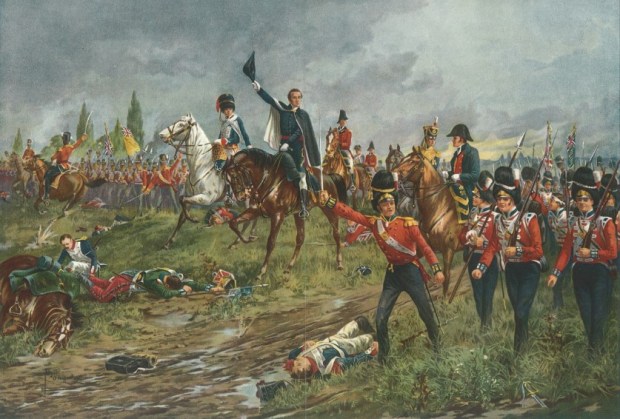
“I say, Carruthers, don’t trip over that dead French chappie”. Waterloo.
As any schoolchild knows, Napoleon Bonaparte was defeated by the Duke of Wellington at Waterloo in 1815. Well, actually, if the curriculum they study today is anything like the one I passed through, largely unscathed, schoolchildren today will think of Waterloo as just be some ancient Abba song that may turn up on a streaming service algorithm’s suggestions list.
Old Brisbane owed quite a lot to Waterloo and its veterans. Ten years after the thundering of hooves at La Haye Sainte, two veterans were in command of a group of soldiers and convicts who hastily erected huts and battled sandflies to set up the first Moreton Bay convict settlement at Redcliffe. They also battled some of the indigenous people of the area, who were understandably displeased that the white people seemed to be moving in to, rather than passing through, their traditional lands.
Lieutenant Henry Miller
The first Commandant, and the one who had the most difficult job, was Lieutenant Henry Miller of the 40th Regiment (1785-1866). He had his very pregnant wife Jane with him as he began to order the creation of the settlement – seeking out water supplies, building stores and dwellings. Jane gave birth to son Charles in November 1824, while her husband wondered if and when desperately-needed provisions would arrive by boat from Sydney. The prospect of the group dying in the middle of nowhere must have seemed all too plausible.
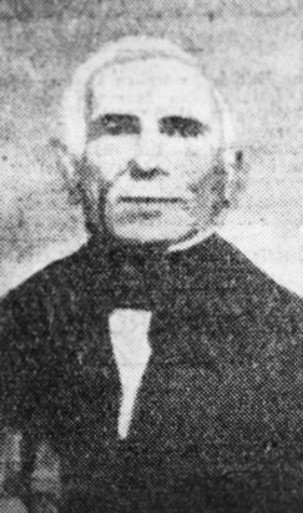
Lt. Henry Miller, the first Commandant at Brisbane, and one of the very few to survive long enough to face a camera.
Miller recalled that time at Moreton Bay as the most difficult of his career in the army. Tougher than facing down the French Emperor in Belgium a decade before. More miserable than the Peninsular Wars.
And once the wretched outpost had been constructed, he was ordered to pack up the whole deal and move it inland, to a spot on the River Brisbane that Governor Brisbane rather fancied he might call Edenglassie.
Lt. Miller remained at Brisbane as second-in-command to Captain Peter Bishop for a few months, then followed the Regiment to Van Diemen’s Land, where he remained for the rest of his life.
Captain Peter Bishop.
Captain Peter Bishop, (c. 1780-1846) 40th Regiment, arrived in October 1824, with the brief to relieve Lt. Miller, and assist in the move to the bonnie shores of Edenglassie. Like Miller, he was an Irishman who had served in the Peninsular Wars and Waterloo, and in peacetime found himself travelling with his Regiment to all sorts of foreign spots, like the convict experiment in Australia.
Bishop oversaw the commencement of public buildings and the beginnings of a plan for agriculture and farming. The aim was to eventually have a self-sufficient settlement – something that never quite came off, largely due to the unfavourable soil and a terrible drought.
Within a year, Lt. Bishop and the 40th were sent to the Illawarra, then later Van Diemen’s Land. The Regiment was ordered to India in 1829. Captain Bishop died in 1846.
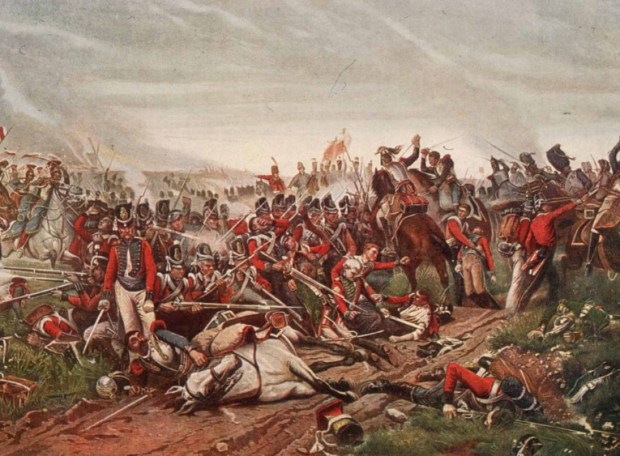
Waterloo. The fierce man-to-man combat probably did look like this.
Bishop’s replacement was a chap named Logan, who had Peninsular War experience, but had not been in the thick of things in Belgium on 18 June 1815.
Major Thomas Prior
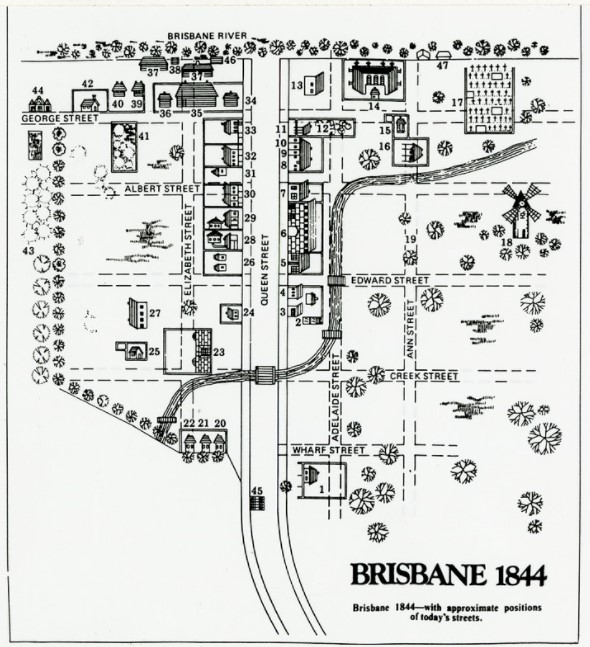
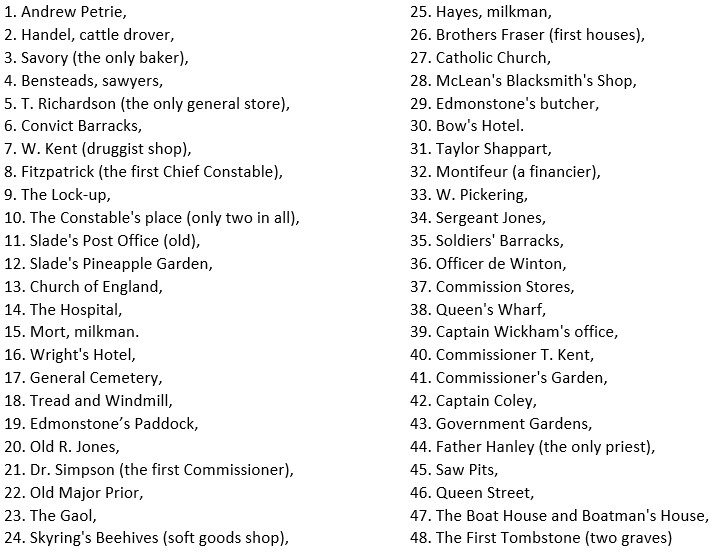
Modern interpretation of the map of Brisbane by Carl Friedrich Gerler, c. 1844 (State Archives of Queensland Flickr)
“Old Major Prior,” as the 1846 Gerler sketch of Brisbane called him, was another Irishman who impacted Old Brisbane, and had fought at Waterloo. He served there as a lieutenant in the 18th Regiment of Light Dragoons (Hussars). Those terms are archaic now, but the Dragoons were an impressive sight, thundering about on their steeds, their golden helmets shining in the sun.
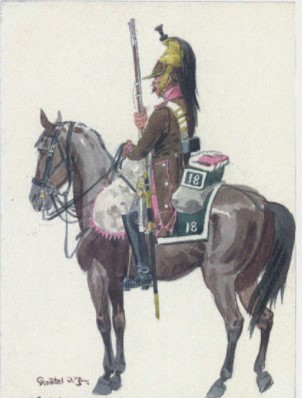
Major Prior lived in Brisbane Town for the better part of two decades, being promoted to the rank of Lieutenant-Colonel in 1854. He was considered to be an upright character who brought a touch of dignity to the rough and tumble of early Brisbane. In the late 1850s, he returned home to the United Kingdom, passing away in 1864.
Harrison, Jennifer. The Moreton Bay commandants and their families, 1824-1842 [Article presented at A History of Women in Queensland Seminar at the Commissariat Store on 13 August 2005.] [online]. Journal of the Royal Historical Society of Queensland, Vol. 20, No. 4, Nov 2007: 148-158.
Louis R. Cranfield, ‘Bishop, Peter (?–?)’, Australian Dictionary of Biography, National Centre of Biography, Australian National University, https://adb.anu.edu.au/biography/bishop-peter-1788/text2017, published first in hardcopy 1966, accessed online 18 June 2022.
Moreton Bay Courier (Brisbane, Qld. : 1846 – 1861), Saturday 30 September 1854, page 2
Moreton Bay Courier (Brisbane, Qld. : 1846 – 1861), Saturday 28 October 1854, page 2.
Queensland Times, Ipswich Herald and General Advertiser (Qld. : 1861 – 1908), Thursday 22 September 1864, page 3
 Moreton Bay and More
Thanks for another interesting article, Karen
Some wee corrections – re the 1844 map – I acknowledge it is diagrammatic, but the Wheat Creek ran parallel to and approximately halfway between Adelaide and Queen Streets (its bed can still be seen down the service laneways in Adelaide Street) – not along Adelaide Street as shown
The convict barracks were indeed in Queen Street, but on the corner of Albert Street and approximately halfway to George Street (not between Albert and George Streets as shown)
I also understand that Henry Miller was *directed* to move the colony to Breakfast Creek, but disobeyed orders and moved to the present site (a wise decision, Henry!) – but this was supposedly a factor leading to his replacement with Bishop in late 1825
And the ‘Edenglassie’ story – possibly apocryphal
Regards Peter
LikeLike
Hello Peter, thanks for the info re the map! I admit to wanting the ‘Edenglassie’ story to be true, just for the heck of it. Very hard to imagine such a twee name being applied to a subtropical city.
LikeLiked by 1 person
Thanks Karen – you’ve inspired me to start chasing up the Edenglassie story!
An initial Google search revealed Melissa Lucashenko’s forthcoming novel ‘Edenglassie’, set in 1850s Brisbane
https://www.uqp.com.au/blog/uqp-to-publish-new-melissa-lucashenko-novel-edenglassie
LikeLike
Correction to my ‘thought’ above – the convict barracks were “not between Albert and *Edward* Streets as shown”
LikeLike
I know Melissa L – I’ve just sent her a message asking if she can advise re the veracity of the Edenglassie name
LikeLike