
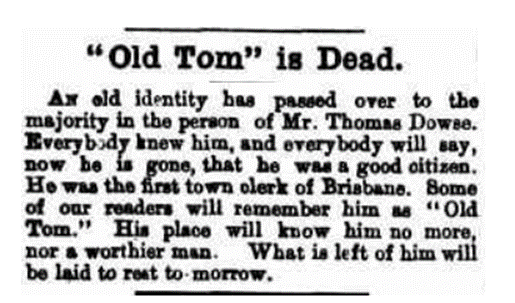
The Late Mr. Dowse.
BY AN OLD FRIEND

“Yesterday, in early morning, at his residence, Milton, there quietly passed away from amongst us, at the ripe age of 76, Mr. Thomas Dowse. When the present Queensland was Moreton Bay, he was always in the front of every political movement, and indefatigable in co-operating to achieve our separation from New South Wales. With very scanty advantages of education, his natural intelligence stood him in good stead. For some years he was the unknown correspondent in Brisbane to the Sydney Morning Herald and was a free and fluent writer on passing topics, while his energy never failed him in his efforts to promote the general good.
“For a long time, he has lived privately, but there are many who will hear of his decease with regret. With him passes into oblivion a rich store of colonial experiences and reminiscences, which it could be wished could have been published. Latterly his eyesight almost completely failed, and this was the sorest privation possible, for his interest in current events never lost its edge. Many who never knew him are unaware of the labour, toilsome and unacknowledged, which Mr. Dowse cheerfully endured when in the prime of life, with no other aim than the progress and welfare of this colony.
“He was singularly disinterested, in fact, far too much so for the advancement of his own personal interests. Though he has gone, the work he helped to do abides, and we daily enjoy social, municipal, and political privileges and advantages, which, if we searched into their origin, we should find associated with the name of Thomas Dowse. His private character was unblemished, and he bequeaths to a widow and family— not much money, certainly — but the memory of a husband and father which they may worthily and truthfully cherish and revere.”
Thomas Dowse, a good-humoured, hardworking and well-liked man, almost died at the age of 15.
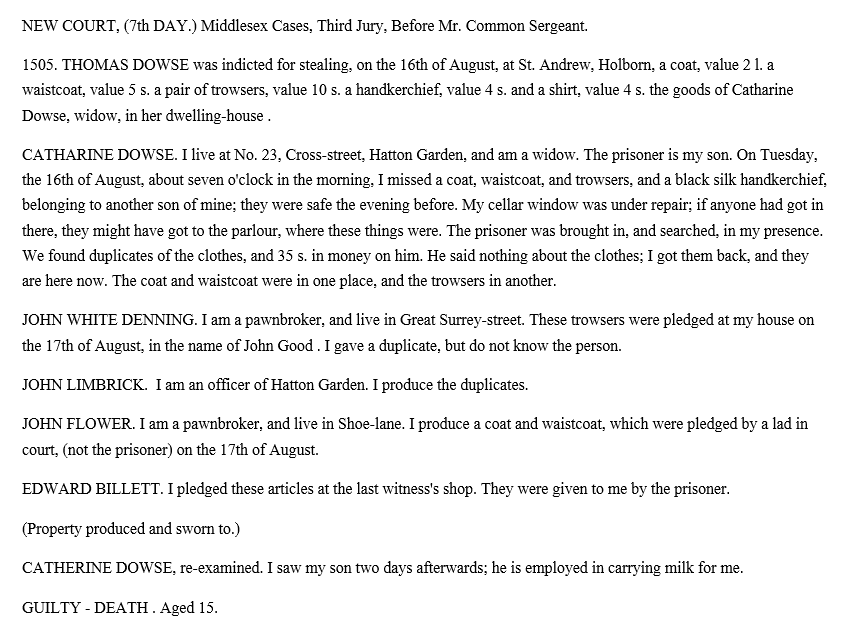
The death sentence was commuted to 21 years, meaning transportation. Tom Dowse must have endured a great deal of terror and suffering, for a silly bit of dishonesty while a juvenile. His mother had prosecuted him. He was condemned to death. He escaped the gallows but faced the prospect of being forced to quit his country for life. What lay in wait on the other side of the world, he could barely imagine.
He was transported on the Florentia in 1828 to Sydney, New South Wales. He seems to have been a thoroughly reformed character for the rest of his life. He married, became a father, and worked as a clerk to the Harbour Master.
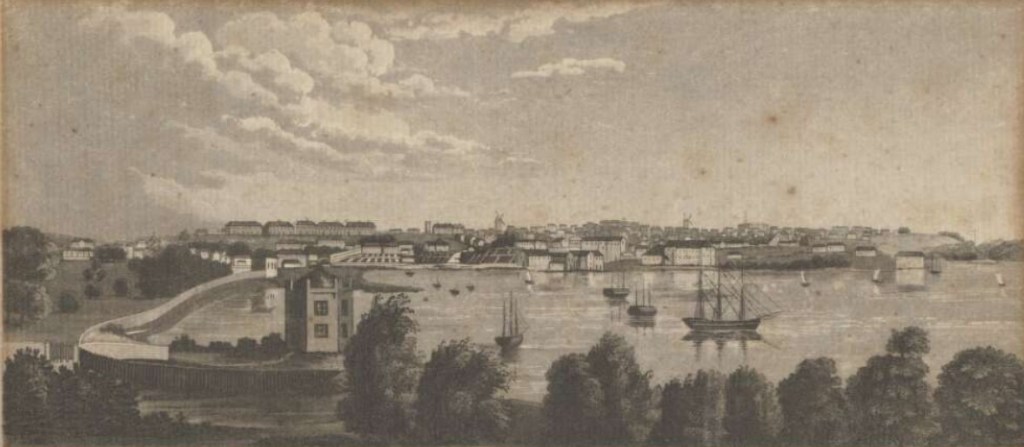
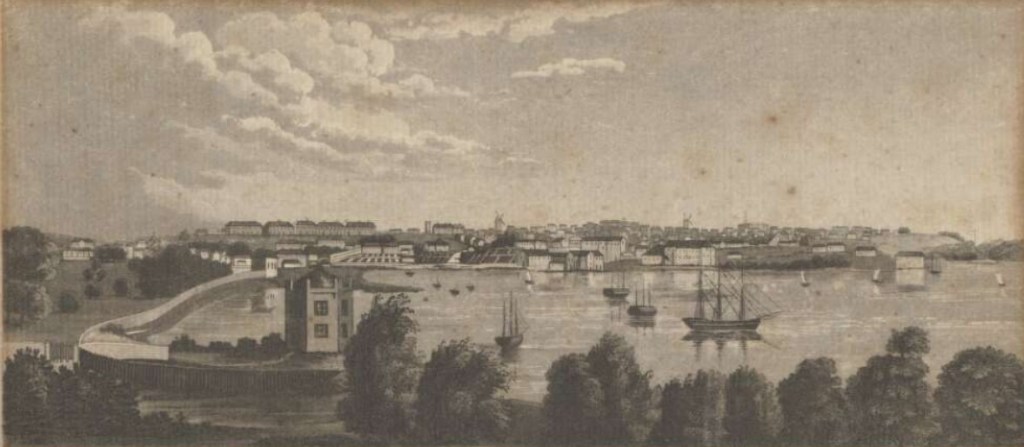
Vue de la ville de Sydney, 1829 (NLA). Seriously, that’s what it is called. I checked.
The financial crisis in the early 1840s spurred him to travel to Moreton Bay and see what an industrious man might achieve there. He worked at anything, travelled the Downs (largely deserted beyond the big stations), and found his footing as an auctioneer.
He barely minded the privations of life in early Brisbane. It takes a special mindset to make oneself at home in, and grow to love, a place where one (initially) had little shelter, dubious rations and only the prospect of hard work to make a living. Tom Dowse saw beauty in nature, and goodness in man. This is Tom reflecting on his first trip to the Windmill:
I recall now that glorious Sabbath morning— the 10th of July, 1842—when I mounted, for the first time, the stairs or ladders that reached to the topmost chamber of the building. The whole settlement lay at one’s very feet, in the calm repose of early morning; the river, placid and bright as an unstained mirror, winding around the valley of the Brisbane, silently, yet with an eloquent silence, filling the mind with the beautiful and the good.
Old Days by Old Tom. The Settlement.

The Windmill, Wickham Terrace – the platform from which Old Tom saw Brisbane.
He also saw the evils of the convict system – especially corporal punishment, which was still being carried out in the 1840s. He described the scene of one such lashing in Queen Street:
I saw a man being lashed to the triangles placed in the gateway, and Captain Wickham and the medical officer, Mr. Ballow at that time the Government officer residing at the settlement—witnessing the operation. A long, white-faced looking vagabond was standing at the side of the poor trembling wretch, fondly stroking down the cat-o’-nine-tails with which the man on the triangles was to be punished with fifty lashes—for getting drunk.
Old Tom and a few others remonstrated with Captain Wickham against the demoralising influence of a public exhibition of this degrading punishment, and prevented a repetition of this offence against decency
Old Times by Old Tom.
Tom Dowse was a public-spirited colonist, and took part in the discussions of the day – abhorring the resumption of convict transportation, supporting separation from New South Wales, and keeping the honest working man’s rights intact in the face of rapacious squatters.
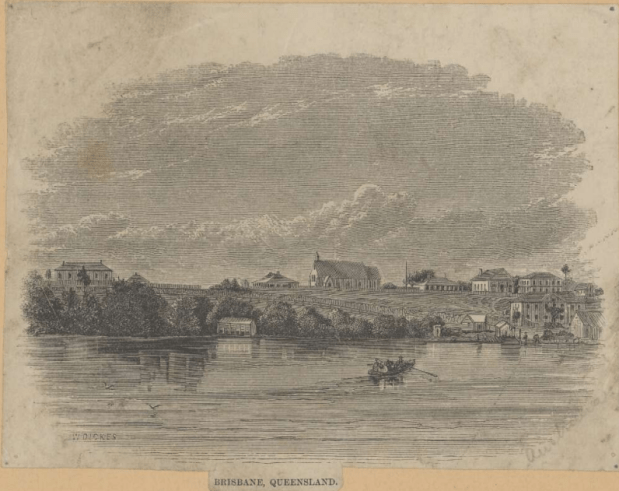
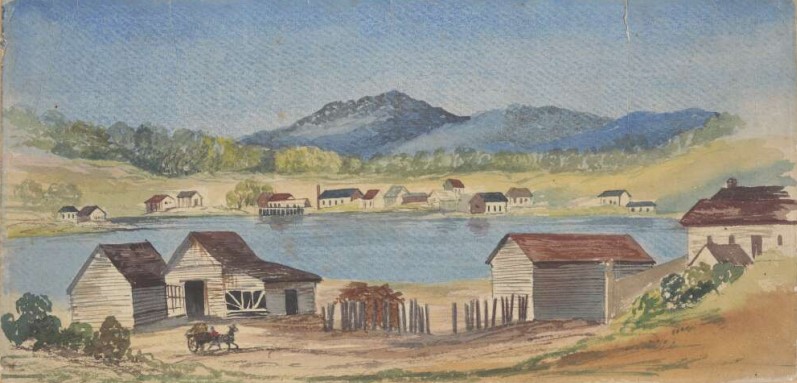
Brisbane c. 1859 (NLA)
Later years found him serving as the Town Clerk of Brisbane from 1862 to 1869 and continuing his business interests. His memoirs, published under the name “Old Tom,” are the only link we have to the days when:
Along the bank of the river, from the boat shed before mentioned to the present site of Harris’ wharf, the ground was occupied by a row of beautiful lemon and guava trees, the graveled walk bordering the same being canopied over by a trellis work bearing up the branches of some splendid vines. At the foot of the slopes the garden was filled in and diversified with some magnificent orange, apple, and banana trees, a cluster or clump of the graceful bamboo over-arching or shading a well of pure spring water.
Old Times by Old Tom

Brisbane Town, 1843 by J.H. Goldfinch. (NLA)
 Moreton Bay and More
Well researched and eloquently written article, Old Tom’s words on looking at the Brisbane River bought a tear to my eye. What an incredible life this man had.
LikeLike