
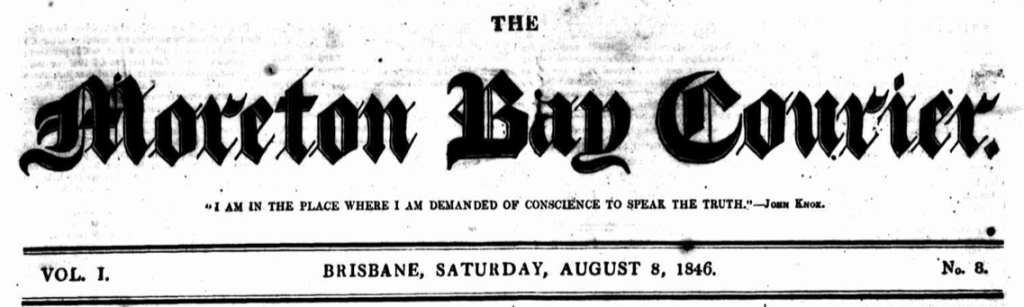
From the eighth ever issue of the Moreton Bay Courier.
Page 1 – Classified Advertising.
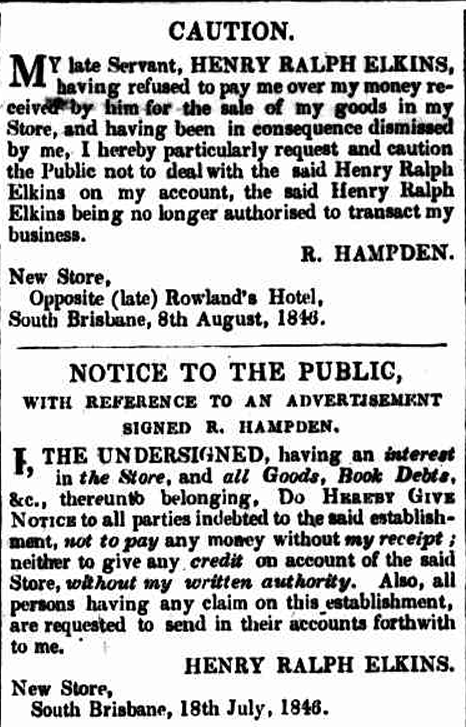
R Hampden and Henry Ralph Elkins were having a terrible barney over a failed business venture. Each man cautioned the public against giving credit to, or generally dealing with, the other. Hmmph.
The indefatigable Thomas Dowse had a Library comprised of 300 volumes of Choice Standard Works to sell by public auction. I don’t know how many of Brisbane’s roughly 600 inhabitants possessed homes large enough to accommodate 300 books, or even three books. Dowse also held instructions to sell, from one of the very rare Government Land Sales, valuable allotments in South Brisbane, opposite Mr D Peterson’s store. Peterson’s Store also ran an ad, offering to store wool and cargo from sailing vessels.
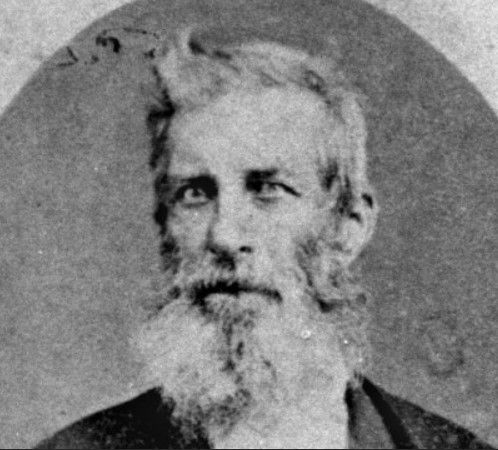
A new resident of South Brisbane looking for actual groceries from a store could go to Hampden, who, when not brawling with Elkins, offered Tea, Sugar, Tobacco, Salt, Epsom Salts and “a few bags real Derwent potatoes.”
If South Brisbane and its few bags of potatoes weren’t your thing, you could look to purchasing some allotments at Kangaroo Point. Lot 1 was next to the public wharf and had a small weather-board cottage. Lot 2 had the potential for a large and commodious building. Part of it had been built, and the bricks for the rest were ready to be laid. It might make an hotel, if finished. Lot 3 had a neat Cottage already on it. Tom Dowse advised, “To the industrious mechanic, this is an excellent opportunity in which to invest his savings.”
George Edmonstone, Butcher, had lost his bay horse, and Mr Wright of the Caledonian Inn had lost a roan mare, rather stout and short-legged (the mare, not Mr Wright). Modest rewards were offered for their return.
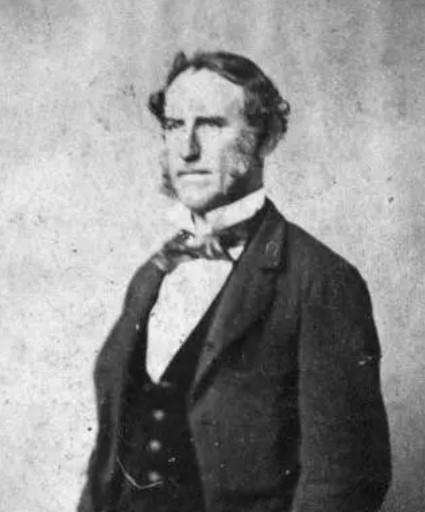
George Edmonstone, Butcher, and later, Politician.
Most of the page was taken up by station-holders offering the services of highly fancies thoroughbred horses. Mentor (by Toss out of Penelope) was standing at Kilcoy. Mr Peacock at Ipswich offered the attentions of Toss himself. Canning Downs offered Knave of Clubs, 16 ½ hands high, and possessor of a long and complex genealogy; Eagle, a bay horse ditto, St Andrew, a roan; and Conservative (got by Gratis out of Theorem). Glengallan, not to be outdone, offered a pure-bred Arab Horse named Beeza, a rich bay named St Patrick, and a powerful Draught Horse named Glancer. Mentor and Beeza were the most expensive options per mare, although Mentor’s owner kindly offered a small discount for more than three mares.
Those not interested in horseflesh, standard works or cottages near the public wharf could look forward to buying elegant jewellery, or enjoying first rate entertainment, dinners and suppers and well-furnished apartments – in Sydney. Sigh.
Page 2 – Shipping, Editorial and intercolonial.
The only shipping news was the arrival of the schooner William, which had a clergyman and four local merchants on board. On board, but not included on the passenger list, were the survivors of the wreck of the Dundee Merchant, which had run aground on a reef near New Caledonia. The crew had taken to the boats, sailed for days, and were picked up near Moreton Bay by the William. When found, they were emaciated and had only the clothes on their backs.
NOTICE TO CORRESPONDENTS.
VINDEX will perceive that our remarks have rendered the publication of his letter unnecessary.
X.-Ne suitor ultra crepidam[i]. Let him apply the meaning to himself.
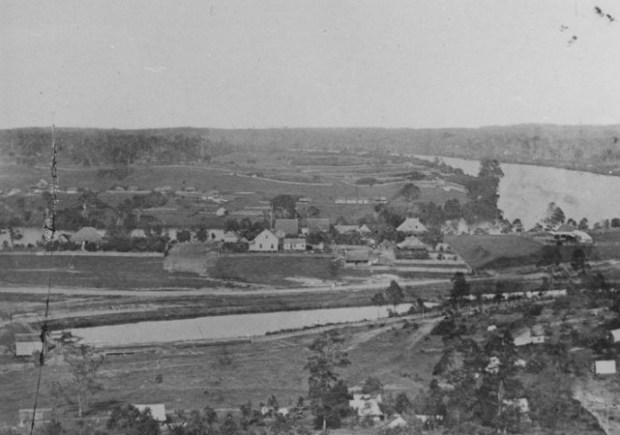
The Courier’s leader for the day was a lamentation on the state of the Reservoir. The stagnant pond would haunt Brisbane for decades, until the construction of the Enoggera Reservoir. The editorial noted that “it is a matter of surprise that Sir George Gipps, when he gave directions to Mr Wade for its survey did not do so (allocate land to be reserved for water supply).” Mind you, Gipps also declared that the streets should be narrower – after all, it wasn’t going to be a proper city or anything. Anyone who has ever commuted in the central business district can thank Governor Gipps for the ordeal.
Elsewhere, surveys had been completed by Mr Burnett, to mark the boundaries of the County of Stanley, and Limestone was looking more like a proper town, but the new settlers there had no (a) Church of England, or (b) school. “If Government do not endeavour to mitigate the noxious influence of the present state of things, by providing the necessary funds for the education of the poorer classes, the town will soon require a gaol rather than a schoolhouse, and a theatre will be more coveted than a church.” Heavens. So, it’s only the poorer classes who misbehave?
In inter-colonial news, Mr Jeremy Devine, aged 71 years, had arrived in Melbourne after walking overland from Sydney.
There were riots in Melbourne, mercifully unrelated to the arrival of Mr Devine, but instead caused by the placement of the “Orange flag” in one of the Pastoral Hotel’s windows. The Port Phillip Patriot bemoaned the global spread of sectarianism.
In Sydney, a “Mayor’s fancy ball” was proposed, and the venue was set to be a building adjoining Cooper’s Distillery. One imagines that it was a quiet evening, and everyone went home to read their scripture afterwards.
Page 3 – News – local and general.
In further Port Phillip news, an elderly man tottered into a Courtroom in Port Phillip, and confessed to a murder in England 30 years beforehand. The Magistrates weren’t sure that he was of sound mind.
Locally, the crew of the Dundee Merchant, now mercifully recovered from starvation and exposure, offered up their services to settlers. “There are several capital shearers amongst them.”
Men had left Brisbane to search for a road that would take vehicles over D’Aquilar’s Range, Captain Wickham was surveying Moreton Bay, a Post Office would soon appear in South Brisbane, and a port had been declared at Moreton Bay.
Page 4 -foreign news, poetry and book extracts.
“An Ode to Tallow” was published. It was a poem. Well, it rhymed. I will not reproduce it here.
Sir Charles Fitzroy was appointed Governor of New South Wales and its dependencies.

An article investigated the effect of the “growing of Wool” upon the soil. Something about gypsum and sulphur.
The Courier condemned the remarks made by Lord Stanley about continuing transportation to Van Diemen’s Land, because England couldn’t manage “all the sweepings of our gaols.” The estate of Sir John Leman, a former London Mayor, was valued at £2,700,000.
After that news, the Courier invited its readers to consider “the immensity of the Universe,” by extracting a passage from Liebig’s Letters on Chemistry.
“The number of worlds is infinitely great; it is inexpressible, indeed, by numbers.”
The Courier’s readers, contemplating another meal of gritty bread and post and rails tea, must have been startled by these cosmic musings.
There was another book extract – this time from a GF Davidson, who had passed decades travelling in “Java, Singapore, Australia and China.” None of his observations of Java, Singapore or China were included. Only the Australian bits. Davidson found life on an Australian sheep-station lonely and wretched, apparently.
Fossilised remains “apparently a gigantic species of the kangaroo” had been found in Geelong. And in Van Diemen’s Land, restrictions were being placed on kangaroo hunting. No person was to hunt kangaroo, except on his own ground.
There was a report on the conditions at Norfolk Island. It could be translated as, “the hot weather made some of the staff ill, and the prisoners took advantage of the staff shortage to act up, but were subdued.”
NORFOLK ISLAND.—The Launceston papers, contain accounts from this settlement up to the latter part of May, which are of a gloomy character. The sultriness of the weather had occasioned considerable indisposition amongst the civil residents. The number of prisoners on the island was 1800, of them about 200 are the most reckless and abandoned of characters, and in consequence of a laxity of discipline on the part of the civil authorities, were in a state of general insubordination. An outbreak had occurred, which was only prevented from becoming serious by the determined conduct of the officer commanding the detachment of the 11th Regiment on duty, who was on the occasion called upon by the Civil Commandant to exercise his authority. During the month of February, the prisoners were very insubordinate, and on the 25th of that month about 800 of the worst of them assembled, locked themselves up in the Lumber Yard, refused to work, and defied the authority of their superintendents. The Stipendiary Magistrate and Civil Commandant being unsuccessful in their attempts to enforce obedience, called in the military. Major Harold, at the head of a strong detachment of the 11th, then called upon them to go to work. This order being disobeyed, the gate was forced in, and the military being marched in took up proper positions. The Major then called upon them, in the name of the Queen, to go to work immediately, or force would be used. An attempt was made to hold a parley, which was abruptly broken off by the officer informing them that if they did not at once evacuate the place, he would fire upon them; at the same moment, he gave the word “ready” to the men under his command, and the click of about sixty muskets coming to position, recalled the insurgents to a sense of their danger, and they hastily left the yard and went to work. – Sydney Morning Herald.
And finally, an expedition to the “inland steppes of Australia” was being undertaken. Camels would be used. Apparently our inland steppes were somewhere north of Adelaide.
[i] Do not sew beyond the crack, or Don’t be a cobbler beyond a slipper. Or possibly, don’t translate Latin online and expect it to make sense.
 Moreton Bay and More