

This sketch by Charles Rawson of the Rawson men admiring their wives’ new outfits (all the way from England!), shows how the better-off women stayed in touch with fashion. Decima and Winifred would have been the toast of Mackay in 1877 in their actually-from-England finery.
Lesser mortals had to be content with at best, the fashions of several years ago, bought from catalogues or on infrequent visits to Sydney to visit that David Jones place. Much lesser mortals had to sew their own, or buy ready-made from local stores.
Hats On!
The dainty.
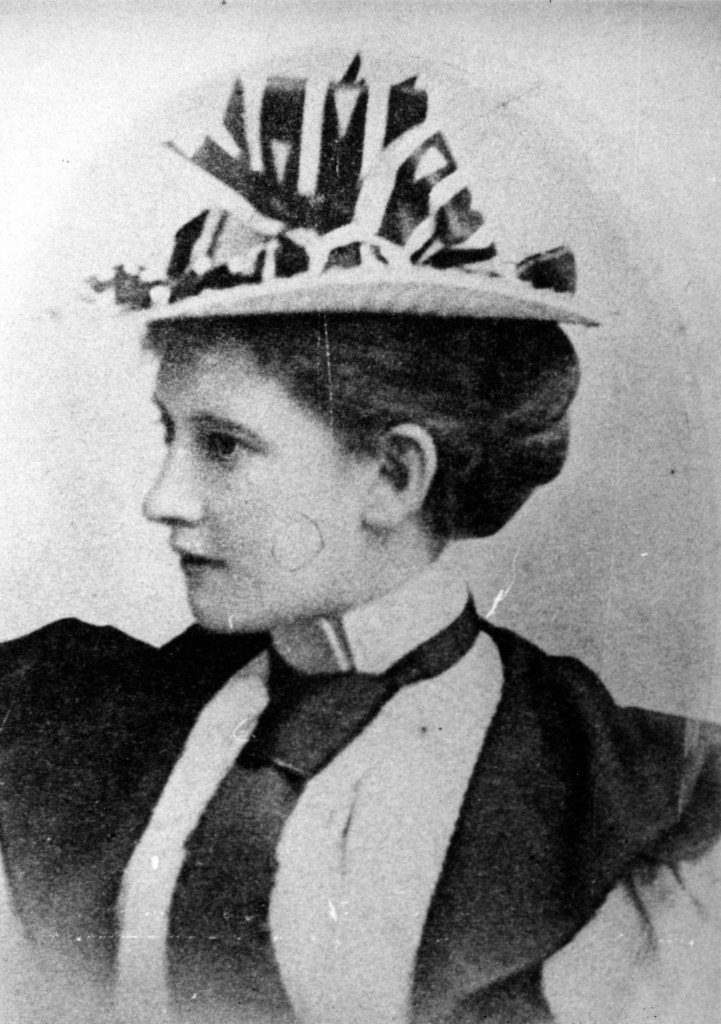
Left: Lilie Stevenson wears a be-ribboned straw hat in 1894. It takes a good deal of flair to wear the combination of a man’s tie plus outre millinery confection
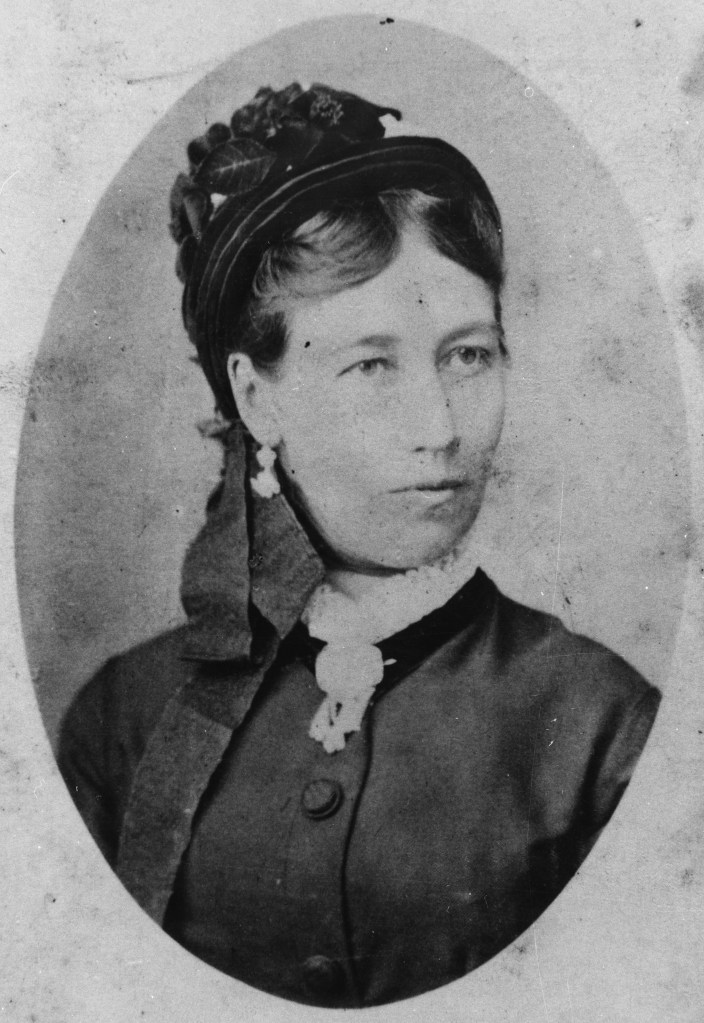
Right: Mrs J. Park of Oakpark Station wears a small bonnet on the crown of her head in 1878. One did not, I suspect, mess with Mrs J. Park. Her taste in home decoration was fairly striking: “A stuffed crocodile is among the bric-a-brac under the Oak Park verandah, along with agates, stalactites and mineral specimens, nestling among the ferns and orchids of the bush house, surrounded by beds of violets.” (The Northern Miner).
The Statement Hat.
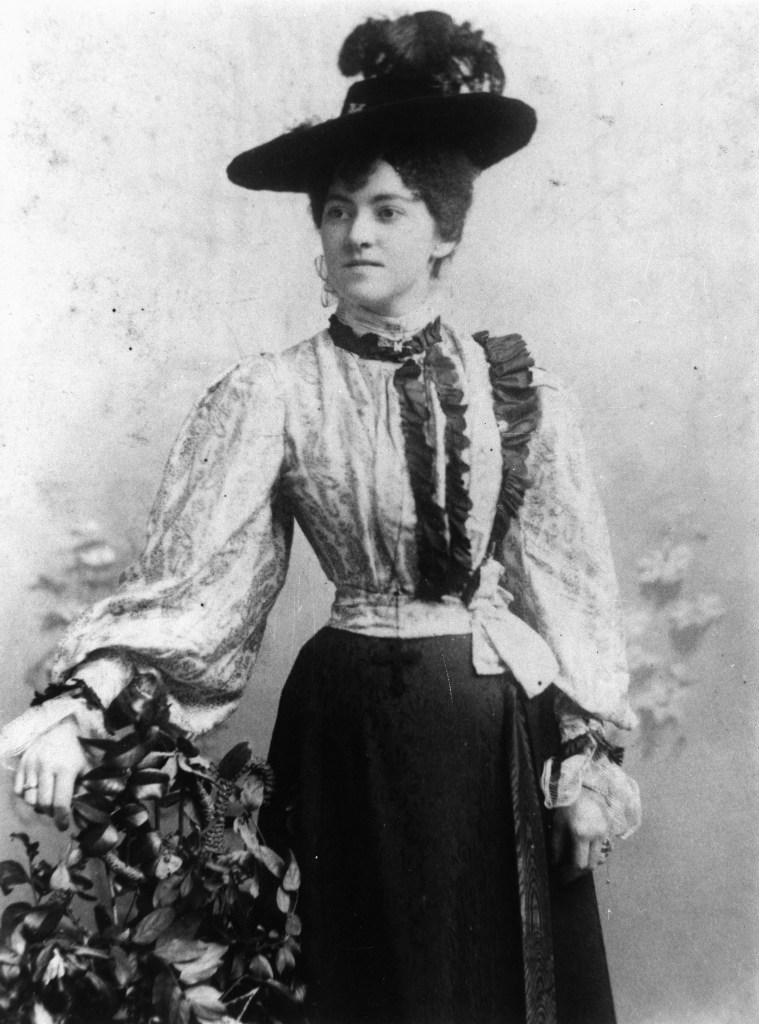
Left: Peggy Benvenuti c 1898, cuts a dashing figure with this plumed and jauntily angled hat. It would be wise to avoid standing behind Mrs Benvenuti at the races.
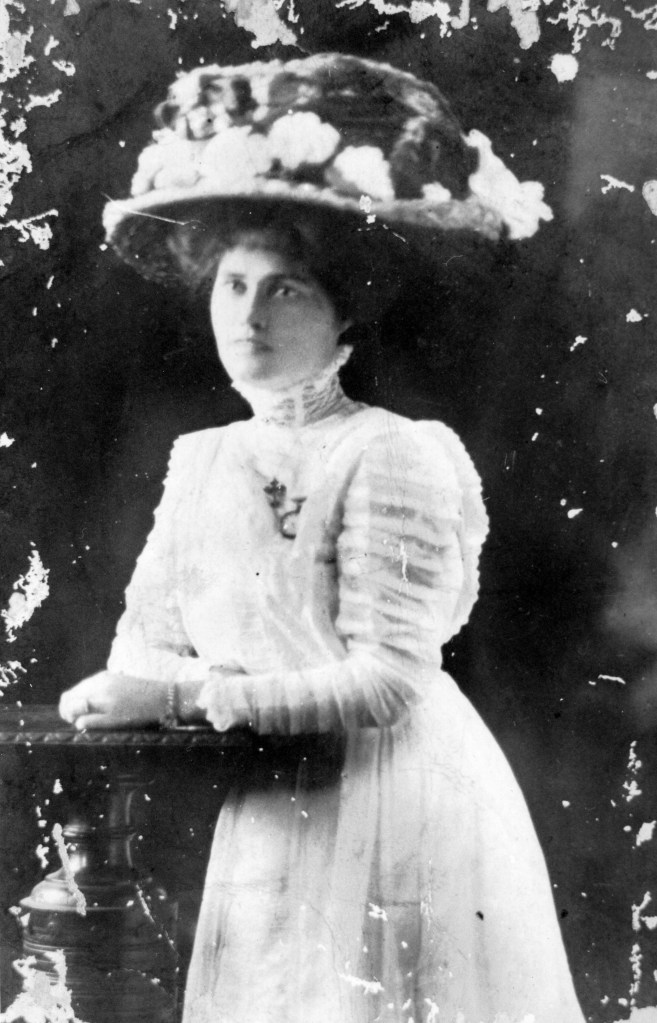
Right: Cis McGrath, c 1890. Ms McGrath’s head is being attacked from two directions. From the south, she has a stiff high collar, and from the north a millinery structure of such outrageous size that would render her a nuisance to chandeliers. Or vice versa.
Headgear of quite reasonable dimensions.
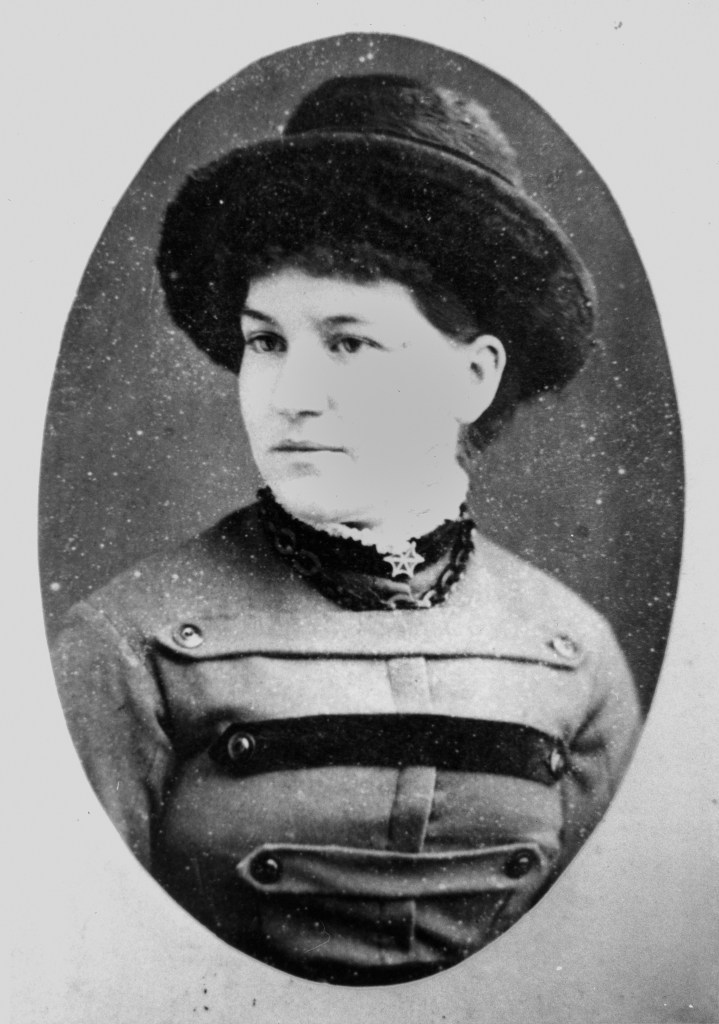

Left: Blanche P. Biddles, aged nineteen years and six months, as the original caption helpfully and precisely tells us, pictured in a small-brimmed hat nestled firmly on an abundant head of hair. Miss Biddles, the caption also goes on to say, was married twice – first to a Percy Smith, and on his death, to William Alexander Rimmington Fullarton. A man, who, judging by the size of his name, may have possessed a hat-buying budget of similar dimensions.
Right: A young lady, whose name and precise age at the time of the photograph is not recorded, wears a knitted beret. And, of course we don’t know who, if anyone, she married.
The matron’s bonnet.


Left: Mary Ann Low, in 1877, wearing a bonnet trimmed with lace and feathers, anchored by a brooch. She doesn’t look at all happy about it.
Right: Mrs Catherine Mewett in 1890 wearing the elaborate black, ribbon-tied bonnet of mourning. If Mrs Mewett chose to follow the Queen’s lead, she would have spent the rest of her life wearing clothing and bonnets like that.
Hair Dos and Don’ts.
The higher the hair, the closer to God.
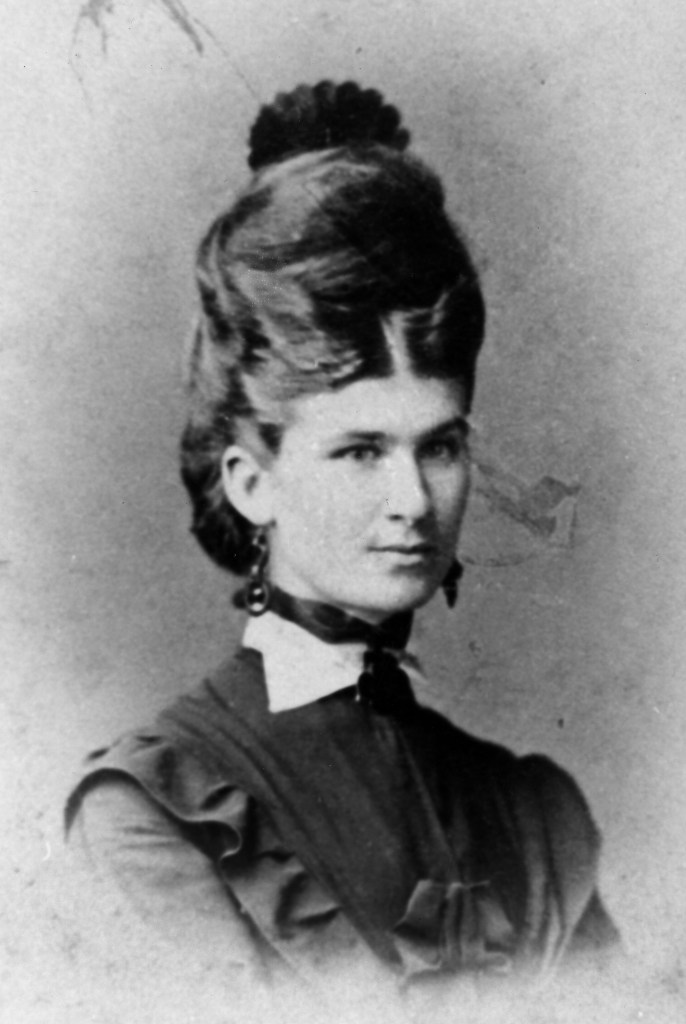

Left: At some point in the 1870s, this remarkably pretty and photogenic young woman, whose name we don’t know, had her hair arranged in this extraordinary bouffant structure, and posed for a studio portrait. At the very top of the edifice, someone has pinned an ornamental comb. I suspect the person who put it in was a long-suffering servant on a step-ladder.
Right: And you thought that the beehive originated in the 1960s… In 1876, Miss Millicent Anne Cairncross, daughter of William Cairncross, put on her most decorative fringed neck scarf, chose pretty drop earrings, and had her hair piled into a ‘do that was ninety years ahead of its time. Her expression is that of an energetic young person who had been required to sit for hours while her hair was coaxed into submission, and then posed for ages in a stuffy photographer’s studio.
The girls with the curls.

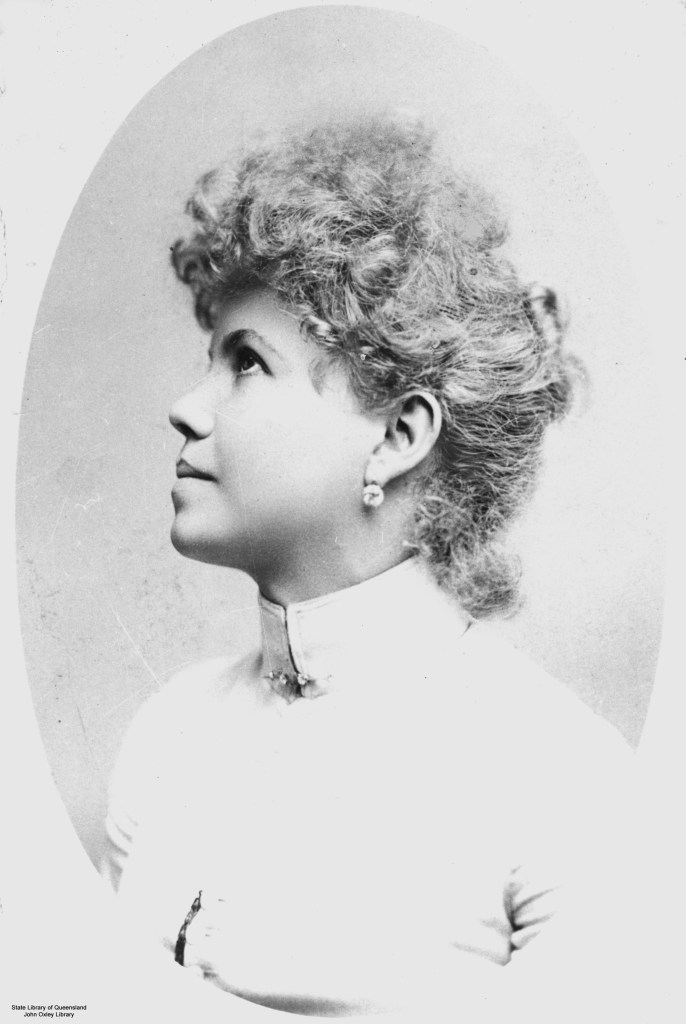
Left: Lela Ballard in 1893, wearing a surprisingly relaxed coiffure that shows off the curls around her face. Miss Ballard may have been wearing long hair gathered up behind her head, or may have been one of those brave souls who chose comfort over extravagant hairstyles.
Right: An unnamed woman in profile c 1880-1890, showing off what could be done with thick, curly hair in terms of height and decoration. Hair conditioner had not yet been invented, and I would hate to have to brush and style such an exuberant mane.
Dresses through the decades.
Fashions of the 1860s.
Crinoline skirts and dresses had been in existence since the late 1840s, but by the early 1860s, they had reached extraordinary dimensions. The underpinning for this type of skirt had originally been a mass of starched petticoats, which would have made them completely unbearable in an Australian summer. Later design improvements included a hooped petticoat or light metal cage underneath. At least they were lighter, even if the garment itself was still cumbersome.
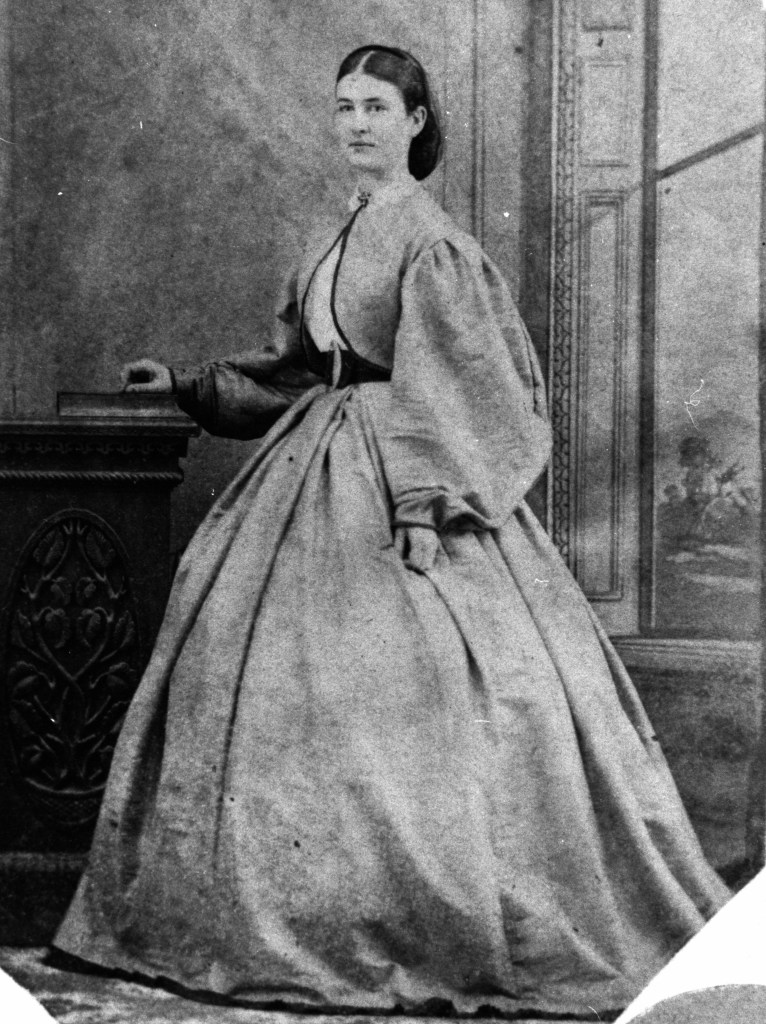
The gentlemen of the press despised the trend as foolish and vain, but women continued to wear them until in the later part of the decade, the trend for wide skirts finally passed. Many women died as a result of their crinolines brushing against a lit fireplace – it was incredibly difficult to remove the burning dresses quickly, and the metal support cage heated to a deadly temperature.


Left: Maria Catherine Leith-Hay in a ruffled crinoline skirt and short-waisted jacket in the 1860s. Maria Catherine, daughter of Ipswich Magistrate Colonel Gray, married James Leith-Hay, also a Magistrate. At the time of the photograph, Mrs Leith-Hay was in her thirties, and mother to a growing brood. She passed away from measles in 1875.
Right: Lady Bowen (Diamantina Roma Bowen), also in a ruffled crinoline. Lady Bowen, an Italian aristocrat born in Greece, was married to the first Governor of the colony of Queensland, Sir George Bowen. Lady Bowen set up many of Queensland’s charitable institutions, and, in between confinements, carried out the ceremonial duties of her office with dedication. She died in 1893.
Fashions of the 1870s

For all her London imports, Winifred Rawson still sewed at home. Here she is, sketched by her husband, wearing one of her own creations.
By the 1870s, the crinoline had disappeared, and skirts had assumed reasonable proportions. A couple could pass through a set of doors without becoming wedged forever.
What the 1870s dresses lacked in breadth, they made up for in decoration. Ruffles, tassels, fringes, ribbons and laces wound their way around garments. The bustle had made is first appearance in the Northern Hemisphere, but did not impact local clothing for some time.

This young lady posed for her studio portrait wearing a dress that contained all of the styling trends of the era, and with a lace-trimmed train for good measure.


Left: The dress this woman wears in her studio portrait is not quite as elaborate as the previous dress, but still manages to contain flounces, ruffles and tassels.
Right: Jane Graham posing with a sprig of wild flowers, 1877. This seated portrait blurs the skirt, but the fringed lacy neck bow and gathered sleeves with long tassels reflect the elaborate clothing of the era.
Fashions of the 1880s
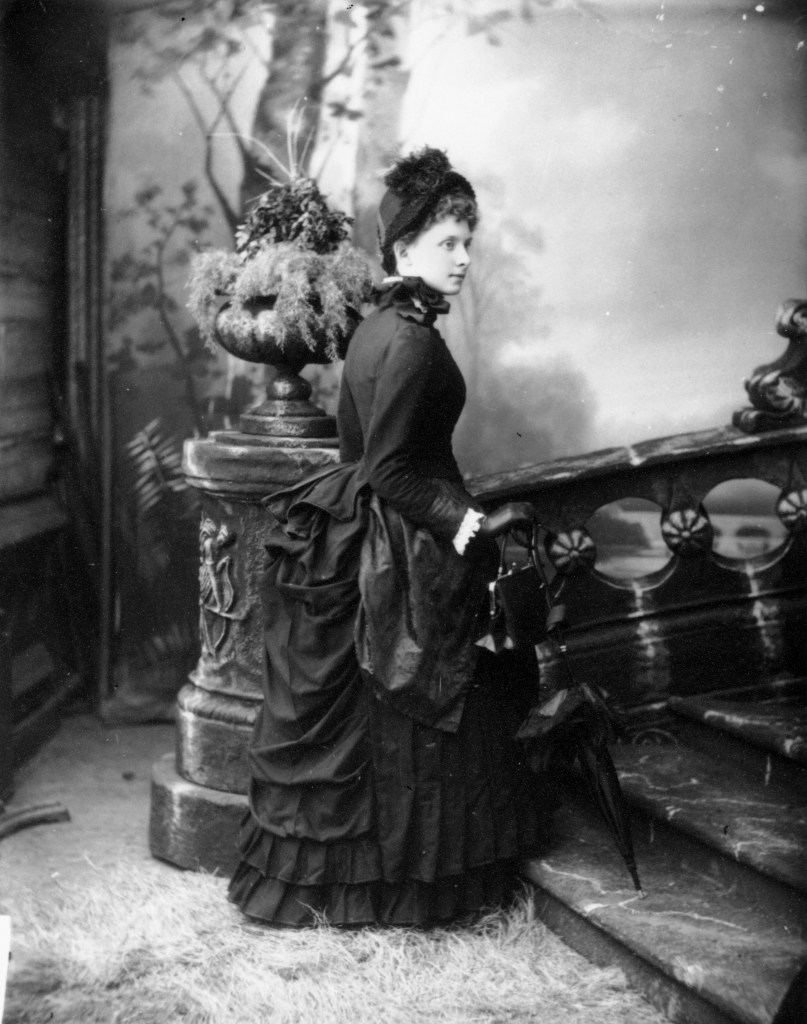

Left: Mrs Jessie Agnes Poulsen, wife of the photographer, modelling the fashions of 1885. Possibly all of the fashions of 1885. She wears a feather-trimmed bonnet with an elaborate bow at the neck. Her costume includes a bustle draped in lightly ruffled fabric, long, lace-trimmed sleeves, tight leather gloves, an over-skirt, a pleated skirt front underneath that, and, finally, ruffles at the hem. She carried a small ladies’ bag and an umbrella as she posed at the foot of the stairs. Presumably, she was concerned about cold, rain, and running out of cash whilst indoors.
Right: The young lady wears a dress with an inordinate number of buttons from the neck to the waist. There is also a decoration at the front of the skirt that could be described (but wasn’t of course) as a “pubic flounce.” Note the incredibly tiny waist, in comparison with the proportions of the rest of the figure.
Dressing for this portrait would have required a great deal of assistance. In order to achieve the waist, her corset laces would have to have been pulled hard from behind. All of those buttons would need to be hooked individually down the front, and then there would be a great deal of hair braiding and fringe curling. This lady must have had several maids. Or one maid with superhuman strength, patience and endurance.
Fashions of the 1890s
Fashions of the 1890s still involved a small waist, a long skirt and detailed sleeves. The leg-o-mutton sleeve made its appearance.


Left: This photograph has the understated caption, “woman in a distinctive outfit posing for a studio portrait 1890-1900.” The elaborate chair that she is perched on just adds to the visual overload.
The costume features a high collar trimmed with elaborate black lace, a pin at her throat with “B” on it over, what appears to be a white, checked lapel with matching neck scarf. The wide lapels are edged in black embroidery, and there are large black leg-o-mutton sleeves. The peplum of the jacket is scalloped, and trimmed with jet beaded embroidery. The jacket’s sleeves feature ruffled cuffs with delicate black lace insets that partially conceal the hand. The skirt appears to be quite simple, although the “wasp waist” is absolutely tiny. The woman’s hair is either very curly, or has been tightly curled at the front and sides. It’s hard to tell whether there is a bun at the back, or whether she is wearing very short hair, which, outfit aside, would draw a lot of surprised glances in the 1890s.
Right: This young woman is wearing a less extravagant version of 1890s fashion. She has a lace-trimmed collar and lace at the font of her dress, and decorated with a rose. The collar is much lower and simpler than that of the lady on the left.
The sleeves are a little puffed at the shoulder, but proportionate to the rest of the dress. The blouse is embroidered, and trimmed at the cuffs. The skirt appears to be quite plain, but is cut off in the photograph. What we can see of the waist indicates some corsetry, but her arm is covering it somewhat. She has a circular hand fan, and an expression that combines despair and defiance. At first glance, she appears to be short-haired, but I suspect that there is a chignon behind. Altogether a more reasonable and slightly more comfortable costume that the previous one.
What to wear to meet Queen Victoria in 1890.

Elena Knox-D’Arcy (wife of an Englishman who made a massive fortune at Mount Morgan and returned to England to be rich and fancy) wears Court dress – white patterned gown with cape, white cap and long veil, and long train trimmed with gold braid.
Honestly, was she even trying? She needed at least five more elements to outdo the lass in the “distinctive” dress. Sadly, Mrs Knox-D’Arcy experienced a long decline in health through the decade, passing away before the Queen.
Fashions for young ladies.
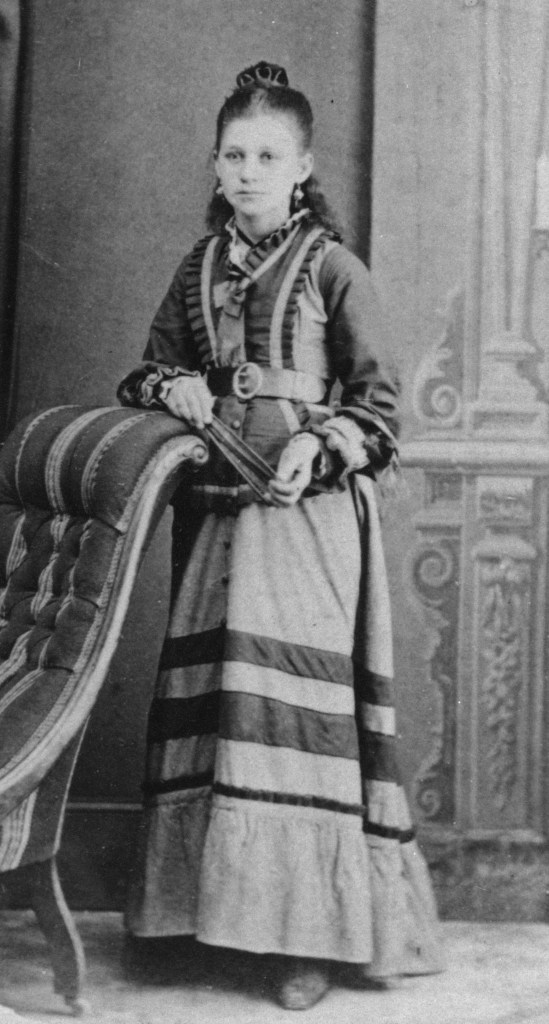
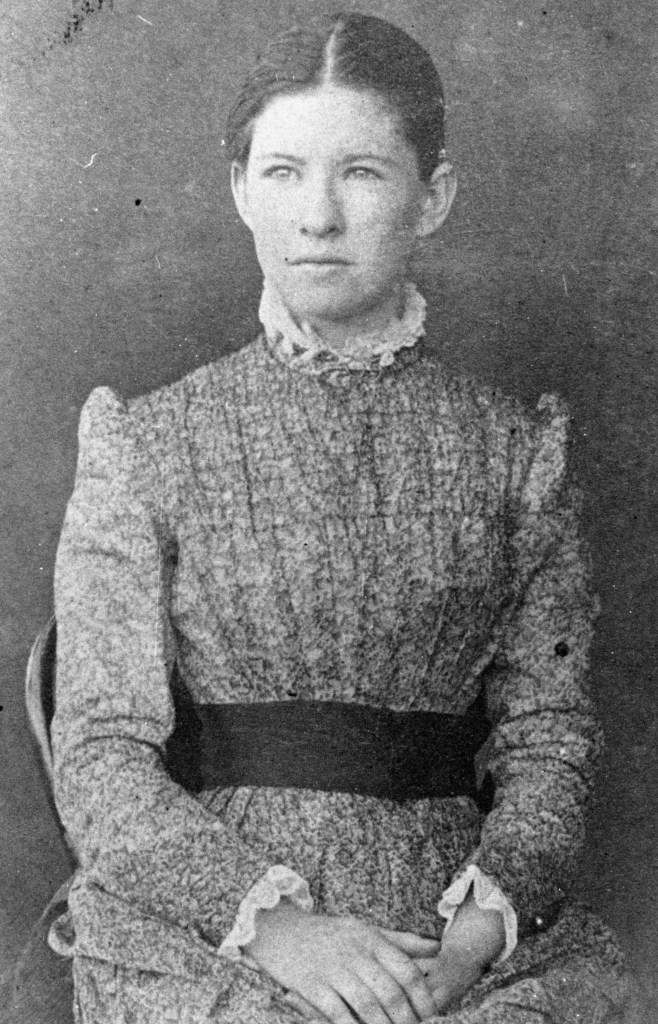
The contrast between the fashions and styling of these two teenagers could not be more marked. On the left, the city teen is wearing a ruffled jacket with a long, slightly less ruffled skirt. Her hair is elaborately coiffed, and she holds a fan. She is a miniature adult (and frankly, that was probably the idea). On the right, Fanny Brown of Saltern Creek Station is the country teen. She still dresses respectably, but she looks more like a girl in her teens. And much less uncomfortable.
Sporting outfits
In order to play sport, one must not look like one is about to play sport. Corsets could not be set aside, even if one was going to play tennis.

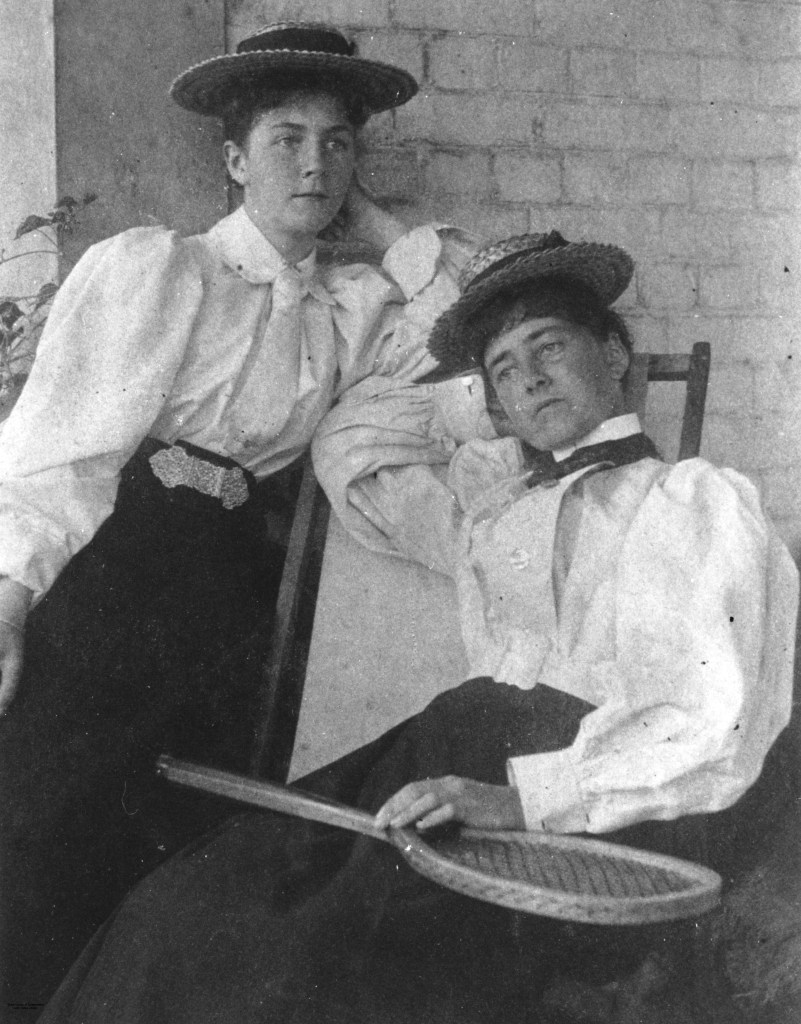

This game of croquet at the Sportsgound at Toowong in 1893 seems to have caused a couple of the ladies to require a spot of reclining. All are dressed elaborately, and yes, all are corseted within an inch of their lives.
The fashions of an earlier era.
It is rare to see a Victorian person wearing clothes and styles from decades before – sure, they would wear old clothes, but tended to pose for photographs in Their Very Best.
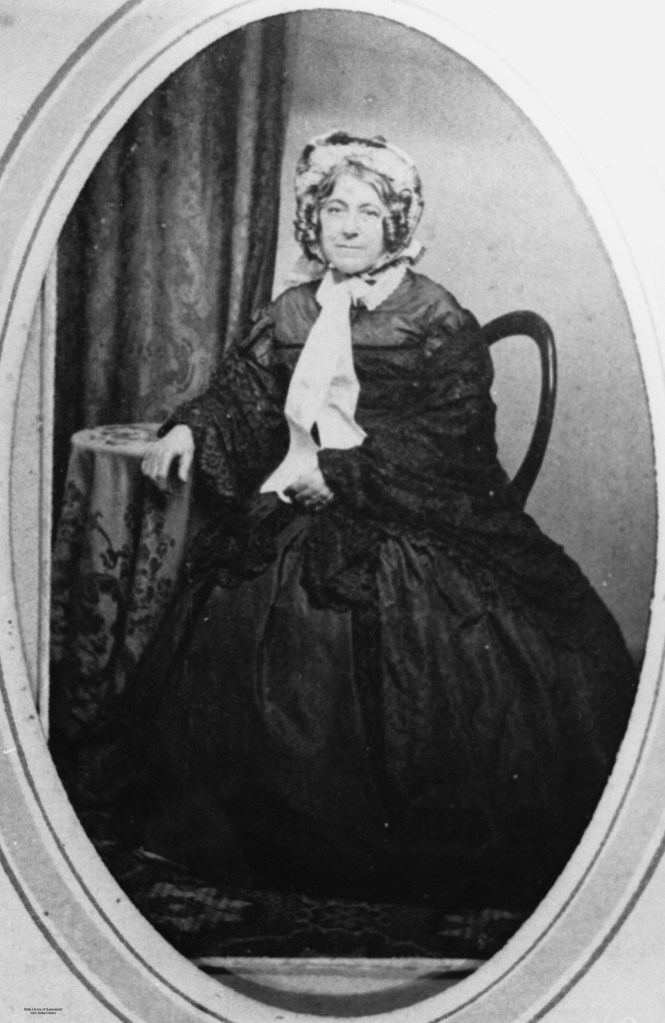

Left: A lady wears an entire costume from the late 1840s. The image – judging by the quality of the photograph – appears to have been taken in the 1860s at least. The ringleted style was very 1840s.
Right: Mrs W H Chambers (wife of the City Surveyor at the time) was still wearing the ringlets of an earlier era as late as 1879. Mrs Louisa Chambers passed away in December 1899 – just before the end of the century. The twentieth century would have baffled her no end, I suspect.
All images are from the State Library of Queensland’s Digital Collection, and are all out of copyright.
 Moreton Bay and More