
Part of an occasional series about convicts who were sentenced to both Moreton Bay and Norfolk Island.
The convicts who arrived by the Forth in 1830 seem to have been a particularly unlucky lot. There were 113 men on board, three of whom died at sea. Quite a lot of them died within a few years of arrival – on the scaffold for offences committed in their new country, and of illness.
The youngest convict on the Forth was a diminutive twelve-year-old errand boy from Cork named Daniel Scannell[i]. He’d been convicted of stealing and given seven years’ transportation. Although Daniel was small, he was a stout, freckled lad, with light brown hair and hazel eyes, and sported an impressive collection of scars and tattoos[ii]. No doubt he’d acquired this ink, and his interest in stealing, to demonstrate his toughness to his peers.

When the Forth landed on 26 April 1830, Daniel was assigned to Carter’s Barracks in Sydney. In November 1830, Daniel did what many other troubled adolescents do when they’re in a place they can’t stand. He ran away. Before he was recaptured, he’d stolen some clothing from a shop. He was apprehended, charged, and tried quickly, and in the inflexible manner of the law at the time, his colonial conviction meant secondary transportation. And that meant three years at Moreton Bay.
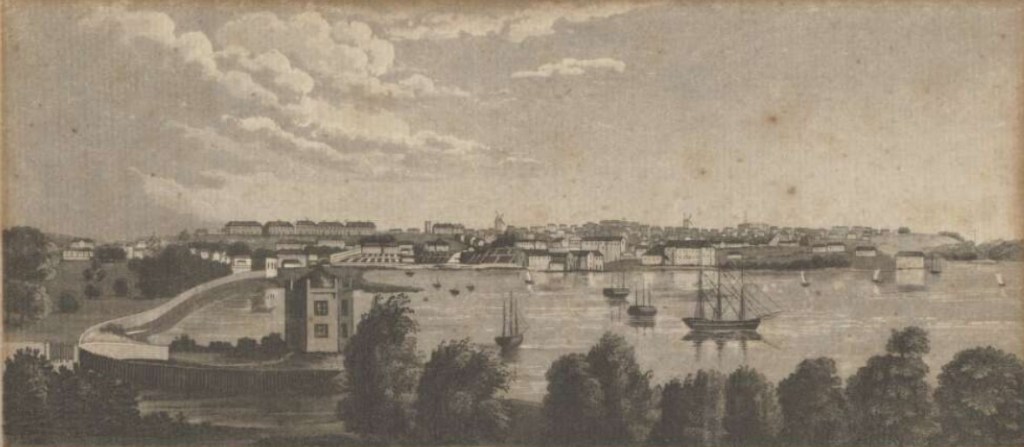
On 1 January 1831, Daniel Scannell arrived at the Moreton Bay convict settlement to do his time. He’d grown an inch in the months he’d been in Australia. He spent two years in Brisbane Town, keeping his head down, and only coming to the notice of the record-keepers when he was briefly hospitalised with diarrhea in February 1833.
On 23 April 1833, eight months shy of the end of his colonial sentence, Daniel paired up with two slightly older convicts to run away. His companions were an Australian-born young man called William Puckeridge, and another Irish convict names James Farrell. Running with other convicts meant safety in numbers, and there was a well-worn path to Port Macquarie that Moreton Bay runaways always followed.

The indigenous people of the Trial Bay area kept an eye out for strangers coming from the North and would bring them to the Port Macquarie Commandant. Scannell and his two companions were spotted and brought in. They remained there in custody with other runaways from Moreton Bay until it was decided to make an example of them by sending them to Norfolk Island.
The Esther arrived at Norfolk Island on 3 September 1833 with the Moreton Bay men, and returned to Sydney on 23 October 1833. Daniel Scannell was still on board. The Commandant at Norfolk Island noted that he was “returned to Headquarters by the return of that vessel,” without any further explanation. Scannell was probably far too young, and far too close to the conclusion of his sentence, to warrant punishment at the Island.
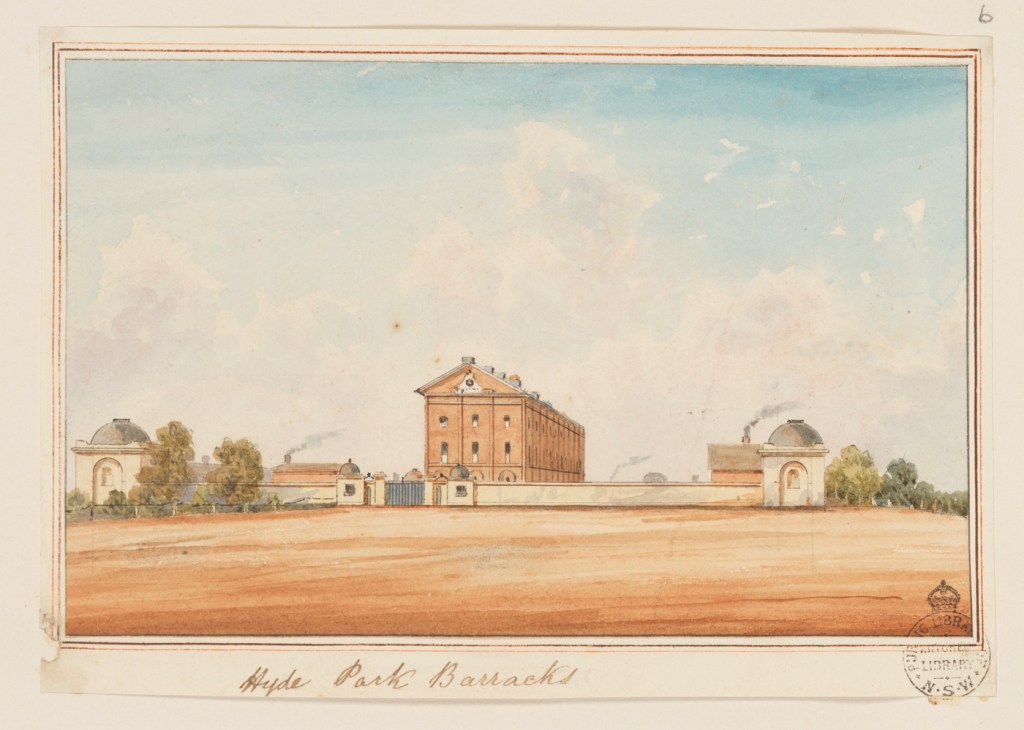
Headquarters meant Hyde Park Barracks, and, with a city to disappear into, Daniel absconded within months. Retaken, and assigned to a settler named Davis on the Punch Bowl Road, Daniel spent 1834 working uneventfully for his employer. Later he was employed by Mr Rayner in Pitt Street.
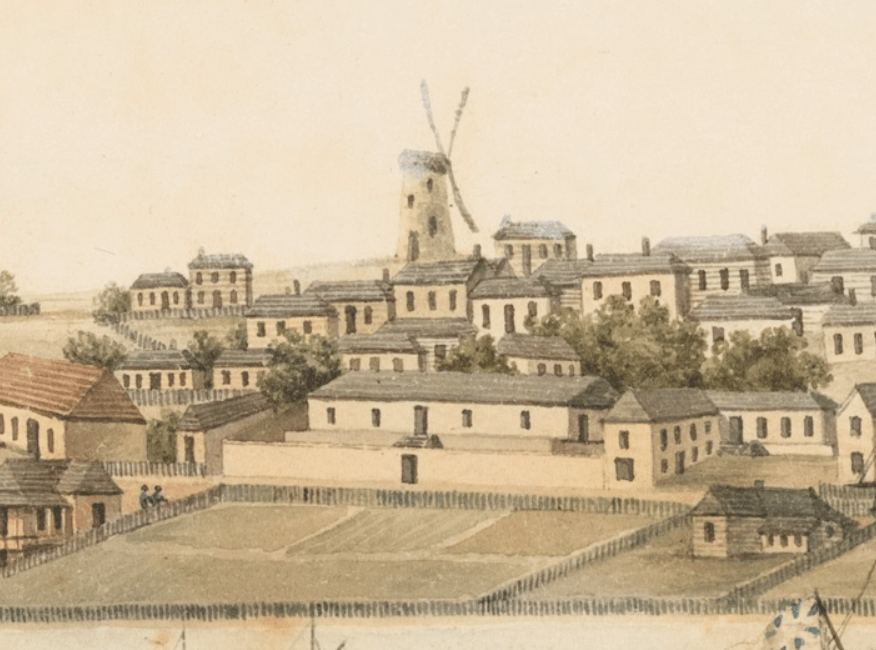
Unfortunately, Daniel, who had been considered a good and stable worker by both Rayner and Davis, fell into bad company at “one of those dens of infamy with which the roads abound.” His new companions were more hardened characters, and Daniel absconded from his work, taking a pistol with him. With his new pals, he became a bushranger on the roads around Sydney.
On 2 May 1835, Henry Barlow, Daniel Scannell, John Carter, and John Bryan stuck up two men travelling in a gig along the Liverpool Road. Carter, Bryan and Barlow searched the two men, and Daniel Scannell presented a pistol from about a yard away. The haul was a watch valued at £5, and a purse containing twelve pence.
The two men who’d been robbed were Captain Clarke (late of the 4th Regiment) and a Justice of the Peace named Manning. They were highly respectable travellers and were able to provide clear descriptions of their attackers. The mounted police located the gang the following day.
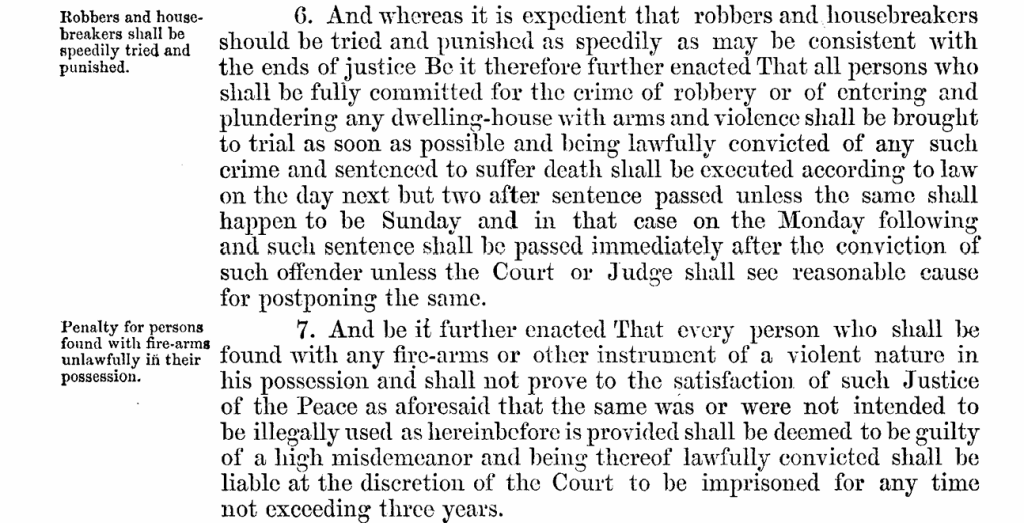
The swiftness of the law in 1835 is hard for a modern person to understand. The offence was committed on 2 May, and the Supreme Court trial was held on 9 May. The men were found guilty, and the sentence was death. Captain Clarke urged the court to show mercy, given that no violence had taken place, but the Chief Justice pointed out the provisions of the “Bushranging Act,[iii]” that required people convicted of armed robbery to be executed in as speedy a manner as possible, as an example to the community.
On 28 May 1835, Daniel Scannell was part of a group of prisoners executed. From his gaol records, it seems that between his transportation aged 13 in 1830 to his death by hanging in 1835, Daniel Scannell had grown nearly eight inches.
[i] Also spelled Scannel, Scammel and Scarmel. And alias Hughes at times.
[ii] Listed on his indent as a cross, sun, moon, DS and other marks on right arm, flower pot on left, ring on second finger of right hand.
[iii] 11th Geo. IV. No. 10. “An Act to suppress Robbery and Housebreaking and the harbouring of Robbers and Housebreakers.”


 Moreton Bay and More