On 15 June 1868, a 38-year-old Lancastrian woman named Hannah Chadwick was admitted to the Dunwich Benevolent Asylum suffering “debility from injuries.” She gave her history in a matter-of-fact manner:
Came to Queensland per ship “Rockhampton” in 1866 with my husband. After a stay of about six weeks, we went to Rockhampton, where my husband worked on the diggings about eight months, when we both had fever and ague. After our recovery we removed to Maryborough and from thence to Gympie. Soon after, my husband attempted to murder me while on our way to a Station where he had obtained a situation for himself and me. After my recovery, I was sent to Brisbane, and thence, here, to await the trial of my husband.
Mrs Chadwick was recorded as staying until 14 September 1868 and was then readmitted on 28 December 1868. After a leave of absence, she was discharged again in May 1869. She had another admission for a month in early 1871.
Behind these blandly recorded facts was a tale of hard times and dashed hopes that stood in stark contrast to the promises of a better life in the colonies that had attracted so many immigrants from Britain’s working classes.
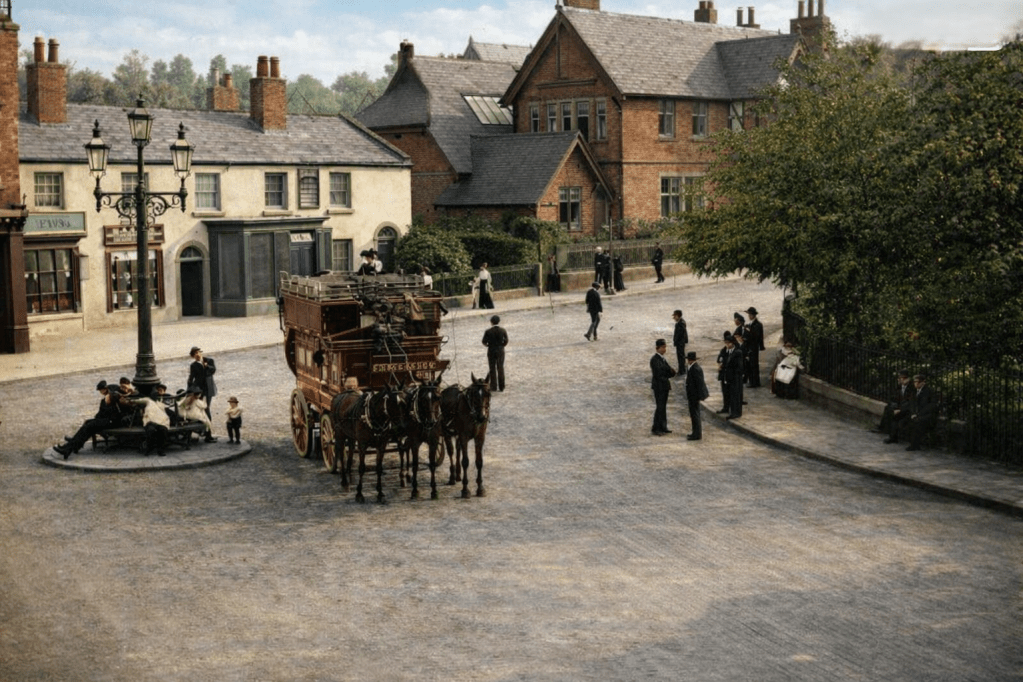
Hannah had been born around 1830 in Much Woolton to John and Martha (nee Lewis) Pennington. John’s occupation was listed as gardener. The family remained there to be recorded in the 1840s England Census, when Hannah was 13[i]. They lived on Delph Lane, later known as Quarry Street. During Hannah’s childhood, the Woolton area began to change. Quarrying started to become the source of the area’s wealth, and hundreds of workers lived there in small cottages in miserable conditions, just a short walk from the mansions of the wealthy.
By time of the 1851 England Census, Hannah’s widowed mother brought her to stay with the Helshaw sisters in the Clevedon Buildings in Toxteth. Presumably, her two sons, now in their late teens, had gone out to work.

In November that year, Hannah married Peter Burns of Wood Street, who was more than a decade older. Peter and Hannah Burns lived in Liverpool until Peter’s death, a poor but unremarkable urban life.
Being a working-class widow in one’s thirties was not a happy prospect, and on Christmas Eve, 1865, Hannah married a labourer named Edmund Chadwick. Edmund Chadwick lived in Wood Street, just across from School Lane, where Hannah lived. Edmund was nearly a dozen years younger than Hannah, but the marriage offered her the prospect of social and financial security.
Emigration to sunnier climes and better prospects must have been the plan, because almost immediately after tying the knot, Edmund and Hannah Chadwick sailed for Queensland on the ship Rockhampton. And from that moment, it’s reasonable to suggest, their lives became immeasurably worse.

As the Rockhampton neared its namesake destination with 440 hopeful immigrants on board, fever broke out. There had been 26 deaths on the voyage, including that of the ship’s surgeon. Arrangements were made to divert her to the Quarantine Station at Moreton Bay to isolate and treat the remaining patients before finishing the journey in Keppel Bay.
The Northern Argus in Rockhampton noted the ship’s unexpected trip into Moreton Bay with a glum approval, because there was no quarantine ground in Keppel Bay. “Had this not been done, the authorities at Rockhampton would have been at their wits’ end (not a very long journey, it must be admitted, for some of them) … We shall, as usual in all our relations with Brisbane, receive the dross of the living cargo after it has been well sieved.” Charming.

Included in the “living dross” were Mr and Mrs Chadwick, who had endured a long, crowded journey in a ship filled with the sick and dying, and then a stay in Quarantine. The newlyweds, who were finding out that they were not particularly well-suited to each other, then commenced their miserable experience in Queensland.


They went to the diggings near Rockhampton, living in tents in rough company, until they both became very ill with fever. After months spent recovering, they tried their luck in Maryborough but found none. Then it was on to Gympie in early 1868 to try and find work.
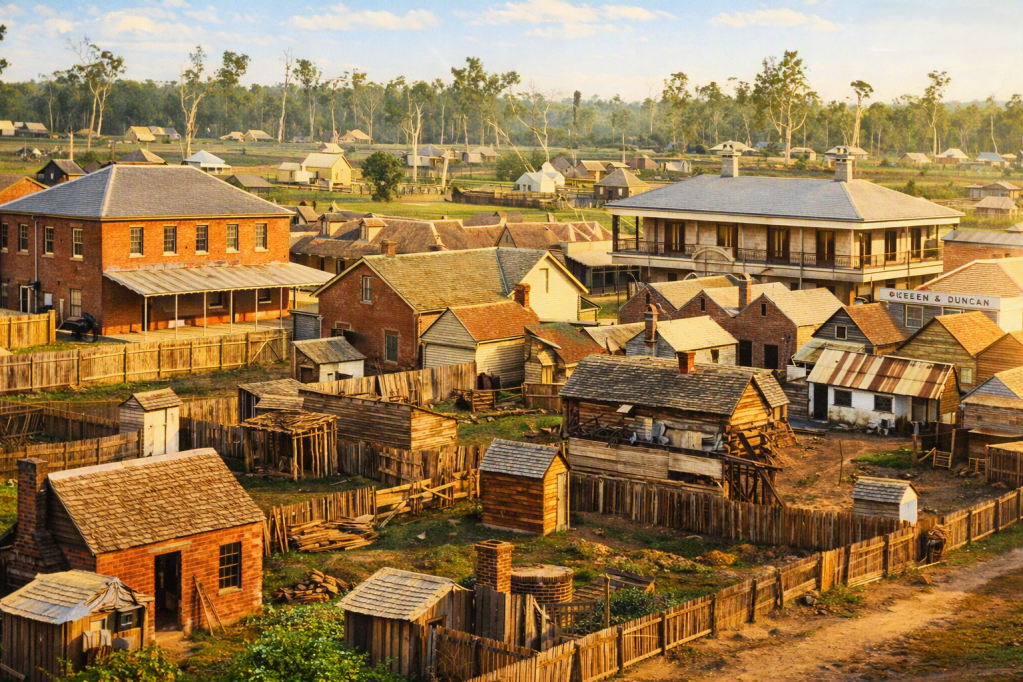
By March 1868, the Chadwicks were existing in a state of misery and mutual hostility. They were living in a tent behind Crocker’s Hotel in Nashville alongside the tents of other unemployed labourers. Edmund Chadwick was jealous of any attention he thought was being paid to his wife. He took out his frustrations violently and had threatened her life on several occasions. At one point, Hannah sought refuge in the tent of another labourer, Charles Murray, for a day or two (an arrangement that both parties insisted was platonic and based on the need to protect her from her violent husband).
Chadwick arrived at Murray’s tent, and tried to attack his wife with a razor, but Murray intervened, and received a nasty cut on his hand. Hannah stayed in Murray’s tent for a day, deciding to go to the local Commissioner to seek legal protection from her husband on Monday. Instead, Chadwick returned to convince her to come back to him. There was a sound prospect of work for both of them. Plus a change of scene. Hannah agreed.
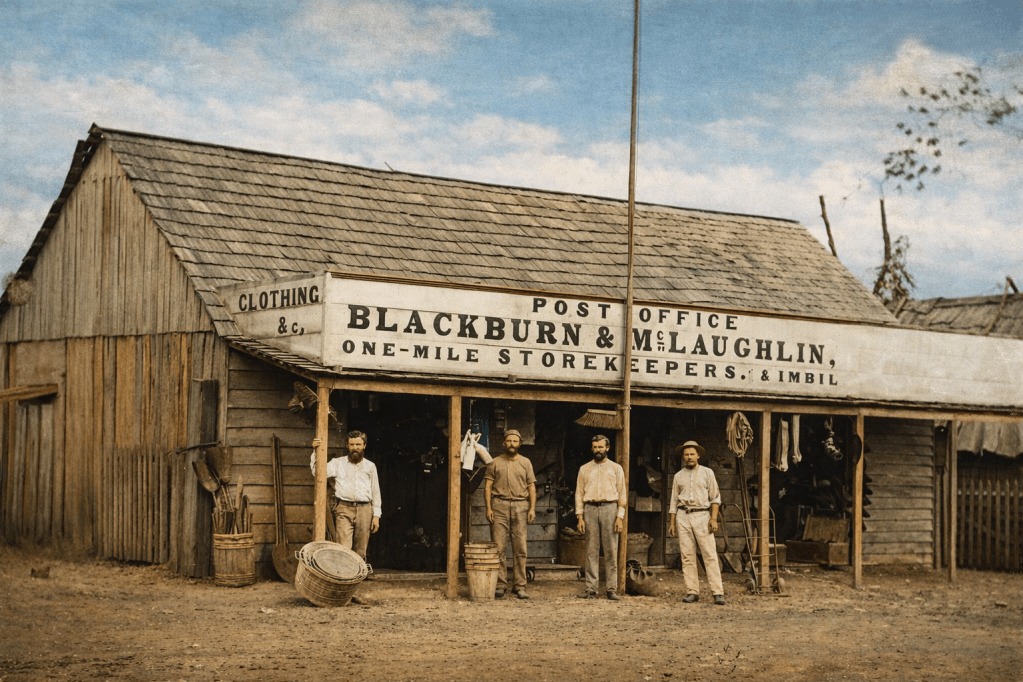
Chadwick told his wife that Mr Booker, of Currie Station, wanted a husband and wife to work there, and that Booker wanted to meet them at his place. They set out on foot the next day, with their two dogs, to walk the twelve miles to Currie. On their way, they met a local named George Spencer, who thought it was odd that the couple should be walking to Currie to see Booker, when the man had an agent in Nashville who did the hiring. Hannah told him that she had been assured by her husband that Booker wanted to see them both in person.
The following morning, David Day was travelling in his spring-cart along the Maryborough Road near Nashville, when he came upon Edmund Chadwick, who was bleeding from a wound to his neck. Chadwick had a razor in his pocket and claimed that his wife had attacked him and then cut her own throat. Day didn’t like sitting next to a wild-eyed, bloodied man who refused to let go of his razor, so he put Chadwick in the back of the cart. He took Chadwick to the Commissioner to make a statement and get medical help.
“Oh, for God’s sake, Ted, don’t do any more to me; let me have time to say my prayers.”
Hannah Chadwick, to her husband.

When Dr Byrne attended Edmund Chadwick at the Gympie Police Camp, he noted one clean cut to the throat that would need a lot of medical care. After hearing Chadwick’s story, Byrne accompanied the police to look for the woman Chadwick had left on the Maryborough Road. He found Hannah, bloodied, exhausted, and barely able to speak, lying under some branches on the side of the road.[ii] She had horrific injuries, which she could not have inflicted on herself (too horrific to be described here), as well as defensive wounds on her fingers and hands. She was so badly hurt that Byrne thought that she would die, and had her dying declaration taken when they arrived back in town.
When the police returned to the spot where Hannah had been found, they found a lot of blood, some belongings, and a small dog that had also suffered a violent death.
Edmund Chadwick was charged with attempted murder, and, to the surprise of the doctor, he and his wife both survived to attend Court and explain what had happened.
Edmund Chadwick pleaded loss of memory and temporary insanity. Hannah Chadwick, who was unable to stand to give her evidence, stated that she did not think her husband was in his right mind at the time of the attack, either.
The Crown Prosecutor then addressed jury, in most eloquent and convincing language, he exposed and fiercely denounced the baselessness of this pretence of insanity, and lapse of memory, and pointed out that all the evidence went to prove that the prisoner calmly and coolly planned and then attempted to compass the murder of his wife. And that she had as it were, risen from the dead to confound him.
Maryborough Chronicle.

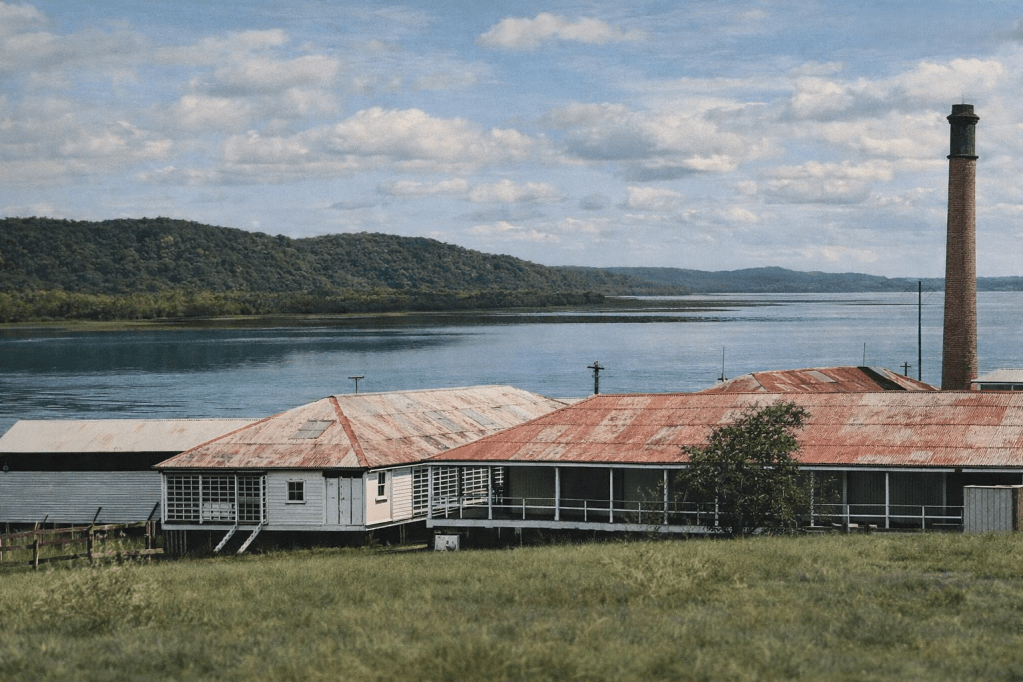
Chadwick was given 20 years imprisonment for attempted murder. He was sent to St Helena Island.
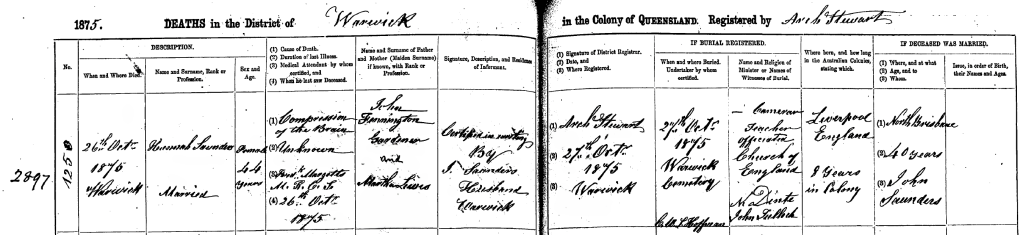
Hannah Chadwick lived on until the age of 44, when, as Hannah Saunders, she died in Warwick in 1875. She had apparently married again at North Brisbane, aged 40 (although I cannot locate a record), to John Saunders. It may have been a common-law union. Her cause of death was “compression on the brain,” which might have been a result of the injuries she received in 1868.
The immigrant dream worked out very badly for Hannah – a husband she didn’t get along with, a long stay on a fever-ridden ship, poverty and hardship, and living in tents in rough mining towns. If Liverpool had been a tough place to live, she had exchanged one type of misery for another, much worse, type. One can only hope that she had some years of some comfort or happiness with John Saunders in Warwick, before she passed away.

[i] Hannah had two younger brothers, William and Charles.
[ii] Hannah recalled that during the day she lay injured by the side of the road, two strangers had stopped by, given her a drink of water, and covered her with tree branches to shield her from the sun.
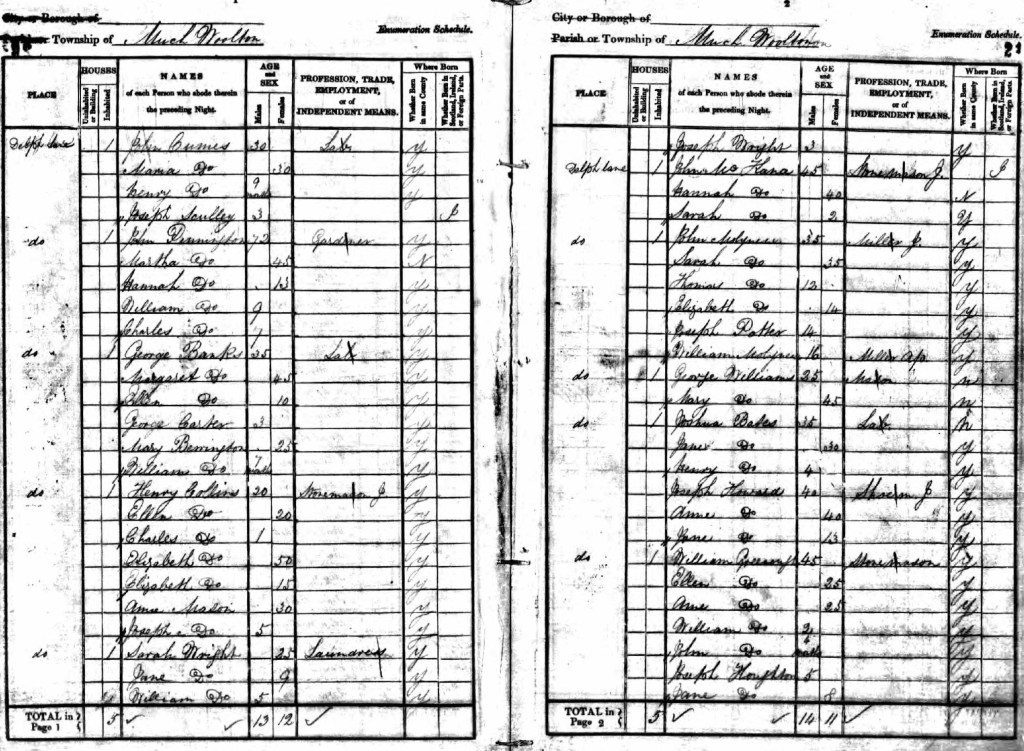
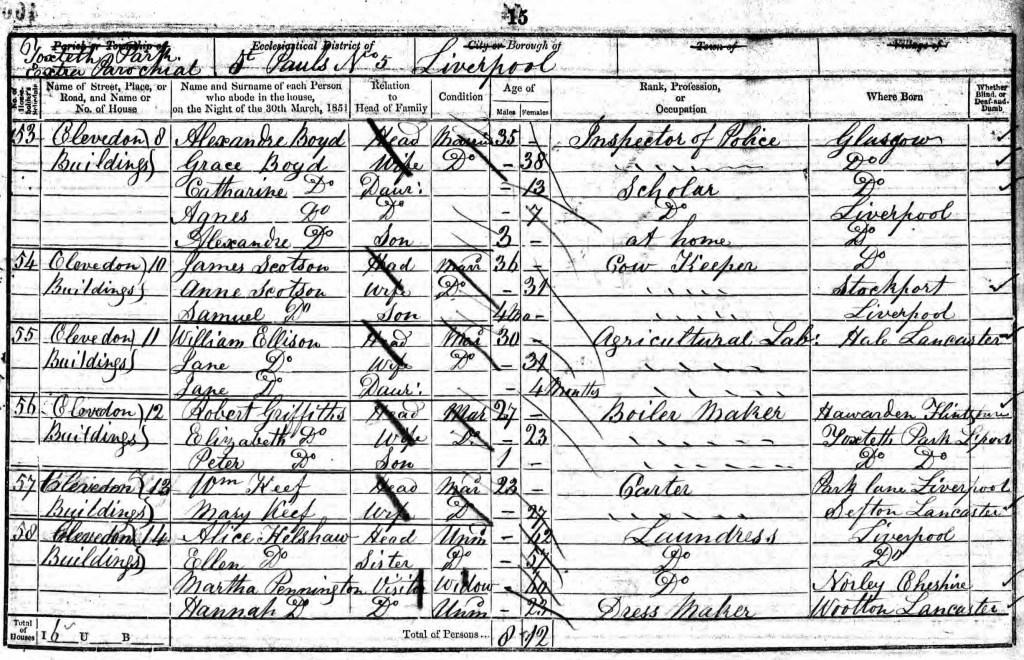
England Census records.


Hannah’s marriage certificates from England.