Some people are determined to make their path in life as tortuous as possible. Their lives are a long, bitter struggle against just about everything they encounter.
One spectacular example was an early merchant at Moreton Bay, Renn Hampden. People sat on him. Others rang his doorbell “wantonly and violently.” People threatened to throw him into the ocean. He spent eight years trying to divorce his wife. He was ordered to keep the peace against his servants, his former servants, other people’s servants, bailiffs, and bathhouse proprietors.
The boarding house, the sofa, and the shattered glass case.
Born into a distinguished Anglican family in Somerset, a young Renn Hampden ventured out to the colonies in March 1842, with a fortune to make. By that July, he was being sat on.
Hampden had been staying in the boarding house of Mrs Jones in Hunter Street, Sydney, no doubt planning the great career ahead of him. After dinner on July 20, he was lying on the sofa in the parlour when one Walter Ogilvy entered the room and sat on him.
The gross indignity aside, there was the matter of a glass case of birds that was broken when Ogilvy’s rear landed on Hampden. It must have been a very determined sitting-on, because it propelled the sofa against the display case.
Mr Ogilvy blamed Mr Hampden and vice versa. Mr Ogilvy threatened to punch Mr Hampden’s head in. Mr Ogilvy and his brother had been in the habit of insulting Mr Hampden, who felt threatened enough to apply to the Court for protection. It was granted in hefty sums.
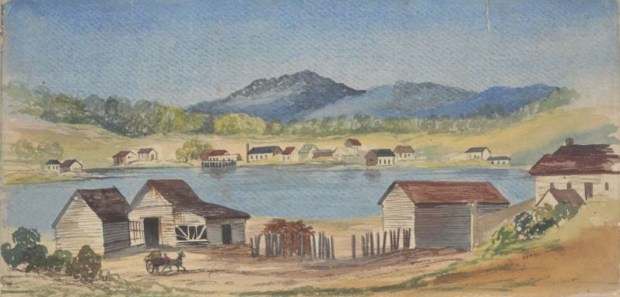
Three years later, Renn Hampden, having made a fairly negligible impact on the business world in Sydney, took the brig Skerne to Moreton Bay to try his luck there. Almost immediately, Moreton Bay rewarded his optimism with a robbery of one of his window sashes in the first month of his occupancy.
A brief, turbulent stay in Moreton Bay.
And of course, within three months of his arrival, he was quarrelling with everyone. He began with a salvo in the Classifieds against a business partner in August 1846.
So venomous, lengthy, and frequent were these quarrels by advertisement in the forties, fifties, and sixties that newcomers often wondered what outlet the inhabitants had found for their spleen before the establishment of a free and enlightened press.
EARLY HISTORY OF QUEENSLAND The Sad, Bad, Mad, but Sometimes, Glad Old Days. (By A SURVIVOR.)
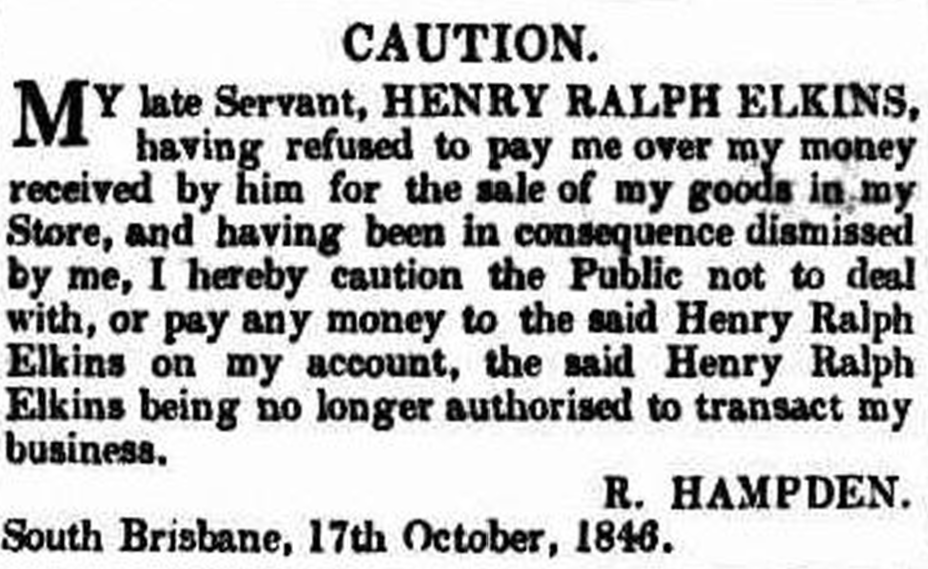
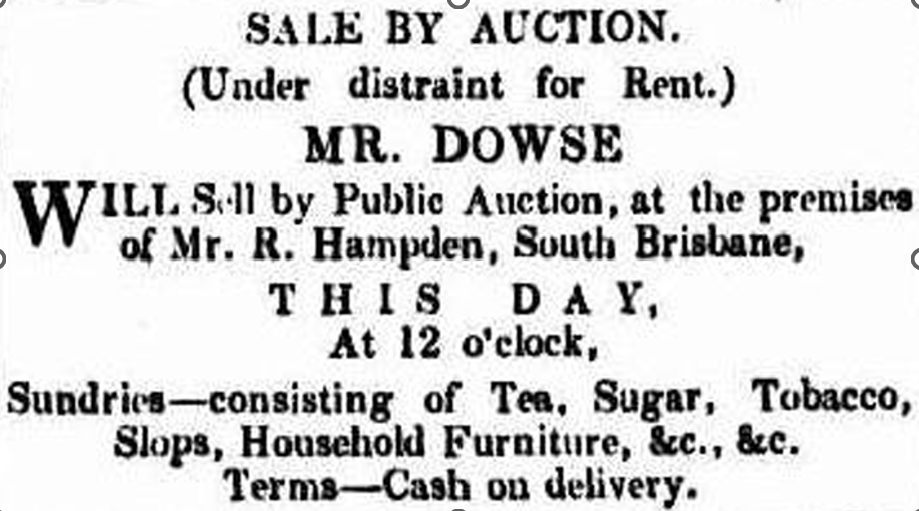
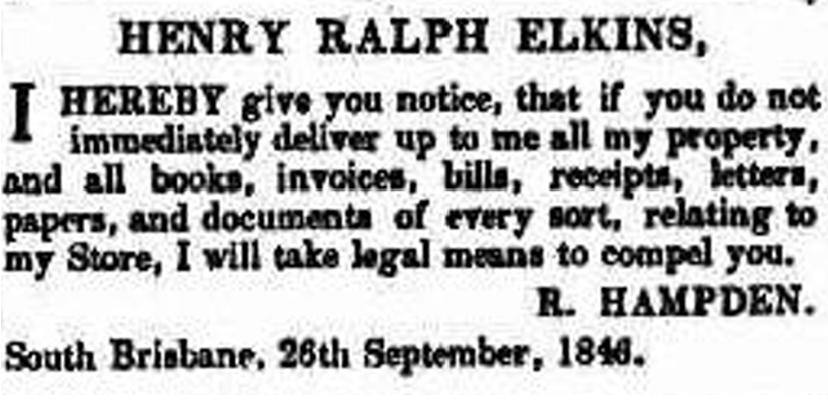
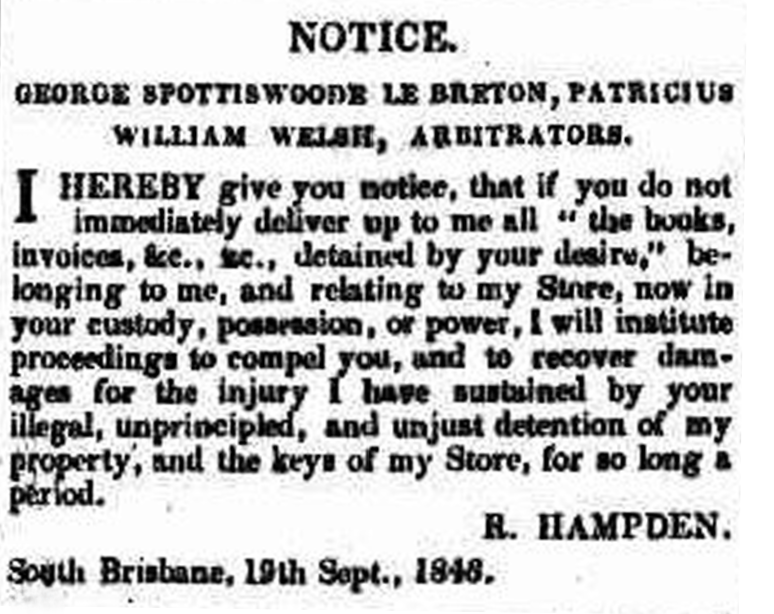
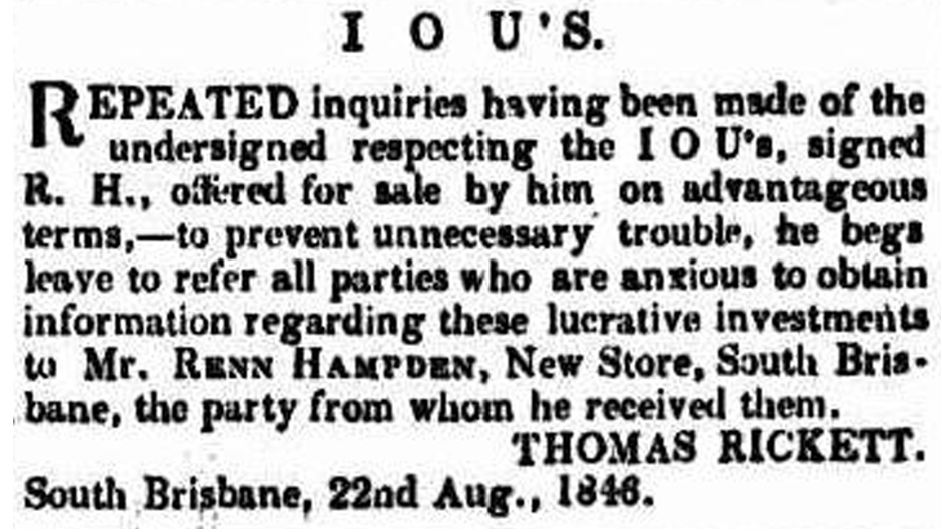
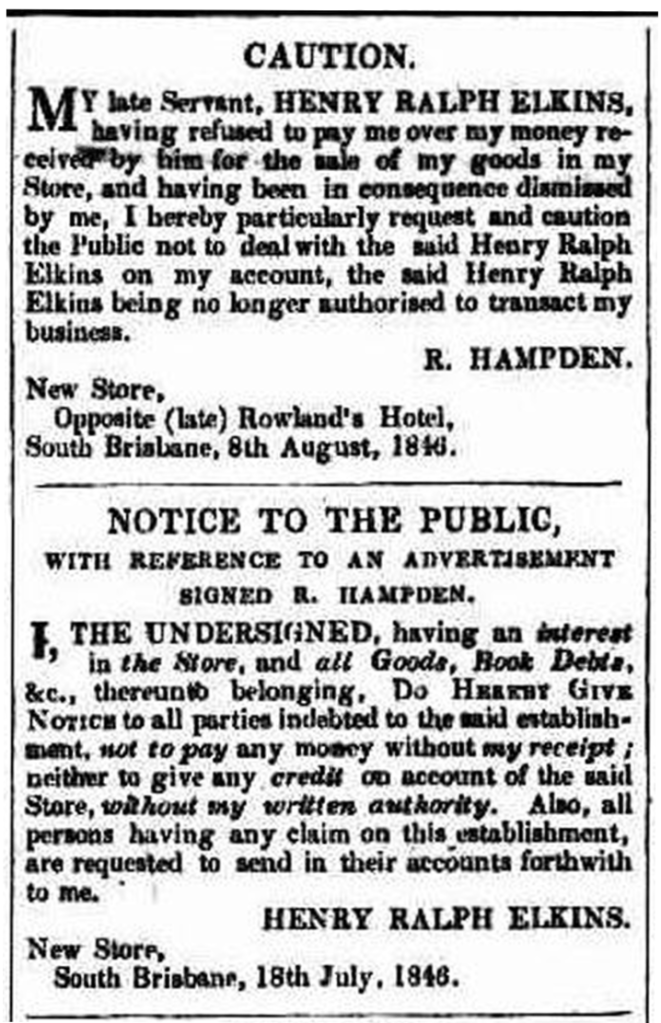
A selection of advertisements taken out by and about Mr Hampden.
Hampden was described by a contemporary as a man with ‘few friends, and who was never free of litigious troubles.” One friend was Revd. John Gregor, who was experiencing difficulties with church administration, and who for a time held services in Renn Hampden’s South Brisbane store when no other venue was made available to him.
Hampden, meanwhile, feeling that he had been wronged by self-appointed colonial elites, pursued former employees through the courts, advertised vigorously, and then quarrelled with the special bailiff of the Court. At gunpoint.
In September 1847, Mr Connolly had enforced a court execution for Mr Hampden, who refused to pay the bailiff fee. Mr Connolly informed Mr Hampden a court date would be impending. Mr Hampden did not react well to the prospect of legal action.
Mr Hampden claimed that Mr Connolly had taken against him because he “would not marry that damned bitch of a daughter” of his. Mr Connolly took exception to this characterisation of his daughter and made to go around Mr Hampden’s counter. Mr Hampden presented a pistol to Mr Connolly, who said later that “had there been no counter between us, I should not have been here today to tell the story.”

Mr Connolly made good his escape from the store and went to the police. The case was heard, and Mr Hampden was ordered to find bail and sureties to keep the peace.
The following day Mr Hampden attended court to complain that Mr Connolly had used threatening and violent language towards him. Perhaps Connolly was still smarting from the comment Hampden had made about his unblemished daughter. The Bench decided to impose the same sureties for Mr Connolly as it had to Mr Hampden. No further eruptions occurred between the men.
Moreton Bay had become perhaps a bit too hot for an English gentleman whom nobody seemed to understand. Or like. Renn Hampden cut his losses and returned to Sydney in January 1848. Almost immediately, he had a legal win in the amount of £125, and perhaps heartened, settled down to life in the southern capital.
An assiduous bather is denied towels.
In Sydney, Renn Hampden avoided sensational press for several years, until his ablutions were tampered with.
Mr Hampden loved a sea-bath. He joined the Woolloomooloo Bay Baths, with a subscription that entitled him to two baths per day. Mr Hampden did not get along with the proprietor, Mr Robinson, and the two men nearly came to blows over towels in 1852.
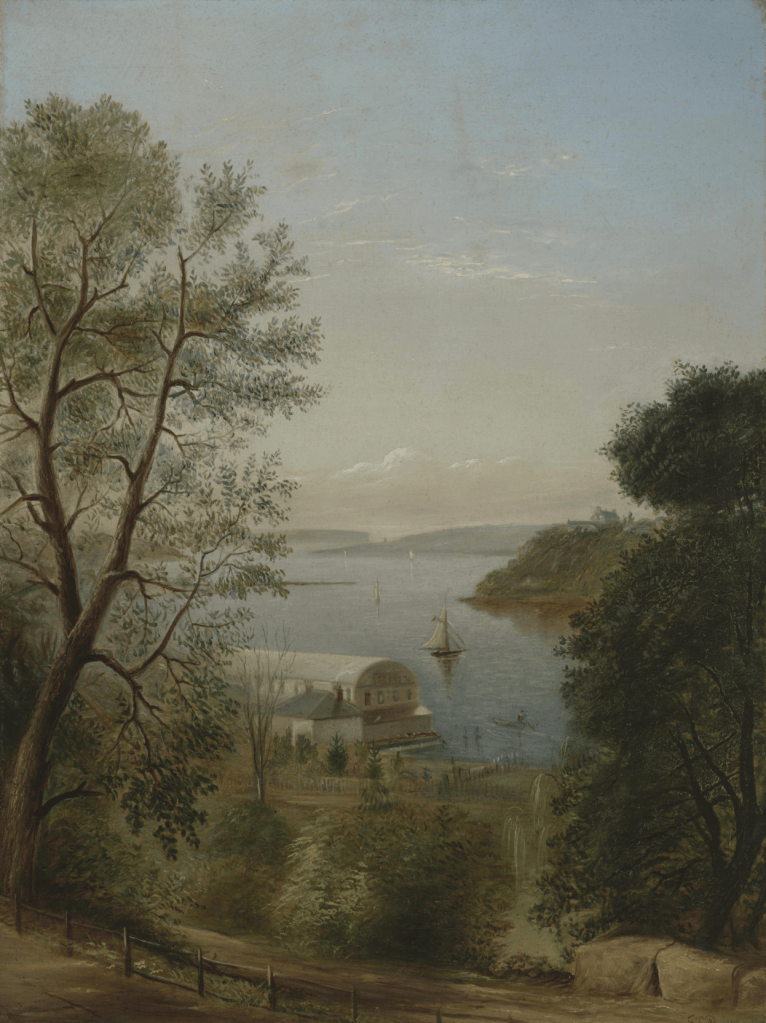
After a soak, Mr Hampden found that there were no towels to be had at the facility. He decided to remedy the situation by going to the manager and asking for towels. Sounds reasonable. Mr Robinson did not appreciate a dripping-wet gentleman in a state of near or total undress barging into his private room and commandeering a large quantity of linen. Mr Robinson threatened Mr Hampden with an unscheduled dip in unprotected (shark-populated) waters, an attitude that Mr Hampden did not appreciate.
The two men sought a solution from the Courts. Mr Hampden was a paid subscriber, entitled to two baths a day until April 1853. Mr Robinson objected to the continuation of the contract.
“I won’t have him. He comes into my private apartment and upsets all my arrangements…If he comes there again, he must put up with the consequences.”
The Bench was unsympathetic, and bound Mr Robinson to keep the peace towards Mr Hampden for the ensuing six months. I don’t doubt that Mr Hampden missed a bathing session during that time. On principle.
Renn Hampden was still a rather tetchy customer, however well-bathed. In February 1854, he directed his solicitors to give notice to a newspaper for publishing a libellous remark about him in one of their columns. The trouble was, there was more than one Mr Hampden residing in the city at the time, and, as the paper pointed out, the Mr Hampden they referred to was Mr John Hampden. “We do not know Mr Renn Hampden of King Street. This surely ought to be sufficient to convince Mr R Hampden that he has applied to himself that which was never intended for him.”
The next time Australian newspaper readers heard of Renn Hampden was a Gazette notice in 1886, advising that Mr Hampden’s estate and effects in the Colony of New South Wales would be granted to his executor. Mr Hampden had passed away in his home city of Bath the previous October.
What happened in between Renn Hampden’s departure from the colonies and his departure from this vale of tears was rather typical of Mr Hampden’s life.
The wanton ringing of a doorbell.
In 1860, Hampden was back in the old Country, and, at the ripe old age of 42, married Ida Cumberland, who was then at the ripe old age of 16, barely. Babies and domesticity followed, but domestic bliss was hard to come by.
In 1861, Renn Hampden summoned Harriet Payne, a former servant of his, for ringing his doorbell on 5 February. “Unlawfully, wilfully, and wantonly.” Miss Payne was employed by Mrs Hampden’s mother and had been tasked with delivering an envelope to Mrs Hampden. Under Mrs Cumberland’s instructions, Harriet called by the Hampden house for any answer and rang the doorbell. No answer. She tried the bell a second time, and Renn Hampden threw a bucket of water on her from a second-floor window. Then he took her to court. The bench explained to Mr Hampden that the girl was acting on the instructions of her employer, and dismissed the case.
In 1867, a servant of Hampden’s, Elizabeth Green, summoned him for using abusive and insulting language. She won, and here’s why. Elizabeth had been allowed to go out with her sister on a Sunday evening between 6 and 9 pm. She arrived back at the Hampden’s at 9:15 pm. Hampden asked her “if she had not got a tongue in her head to ask the time, and she said she was sorry, and that she didn’t know that she had exceeded the time. Thereupon he got very angry, and called her a bloody fool, and said her sister, who had come for her to go out with her, was a bitch. She had been in the service for six days, and the fear of these and other threats occasioned her to leave the house at once.” Hard to blame her. Mr Hampden was bound over to keep the peace.

Renn Hampden’s final nemesis was Mrs Renn Hampden. In May 1868, he filed for a divorce from his wife on the ground of her adultery with an Albert Thomas. Mrs Hampden counter-filed, denying the adultery, and made a few accusations of her own (well, 31 of them). Clearly, a private detective had been hard at work, and Mr Hampden had not been discreet. At all. Claims and counterclaims flew, and in November 1873, Mr Hampden consented to his petition for divorce being dismissed with costs. Rather than air the dispute publicly. Phew.
Renn Hampden, gentleman, went to his reward on 30 October 1885 at Bath. Had had suffered “disease of heart, softening of brain and exhaustion.” He had probably exhausted everyone else by that time. One person outlasted him, and by more than half a century, and that was his much younger wife, Ida. In 1891, she emigrated to Australia and remarried. She died in 1937 in Perth, Western Australia, at the age of 91.