
Indooroopilly Indooroopilly’s name origin is a little obscure. It may be an indigenous term meaning “gully filled with leeches” (eww), but it may be a European invention based on Yindurupilly “gully of running water.” I’d go with the running water over the leaches, thanks. At first, it was a place for country homes and farmland.Continue reading “The A-Z of Old Brisbane: I and J in colour.”
Category Archives: The A-Z of Old Brisbane
The A-Z of Old Brisbane. Some of our “H” places.
Hamilton over the years. Houses and the riverbank, Hamilton. Herston’s beginnings. Highgate Hill then and now. Hotels in old Brisbane. The Brisbane Hospital. All images, unless otherwise credited, are from the State Library of Queensland.
The A-Z of Old Brisbane: from Gaythorne to Gumdale.
Gaythorne. Gaythorne, on Brisbane’s north side, nestles between Enoggera and Mitchelton. Over the years, it grew from homestead farms to modern suburbia. The Pickering family established their homestead and farm, “Rosehill” there, and grew a family of five, some rather fine grapes, and wine from those grapes (the quality of the wine is lost toContinue reading “The A-Z of Old Brisbane: from Gaythorne to Gumdale.”
From Gaythorne to Gumdale
The A-Z of Old Brisbane in Photos Most of the suburbs in the “G” list of Brisbane suburbs were photographed in the very late 19th century through to the late 20th century. The Brisbane City Council’s Brisbane Images collection supply most of the 20th century photos. And some of them are from a very CityContinue reading “From Gaythorne to Gumdale”
From Female Factories to Flying Piemen – “F” stories.

Female Factory, Queen Street The Female Factory was built during the Logan era of the Moreton Bay Penal Settlement to house the unruly female offenders that Sydney was dying to get rid of. Security in the Queen Street facility was somewhat wanting, and, in order to protect the female convicts from unwanted attention from maleContinue reading “From Female Factories to Flying Piemen – “F” stories.”
The A-Z of Old Brisbane – Fairfield, Fig Tree Pocket and Fortitude Valley.

Fairfield Fairfield’s European history began around 1850, with the establishment of dairy farms in its wetlands. The photographs here show the gradual development from farming to suburb through the 19th and early 20th centuries. L: R Crump’s Family Butcher Shop on Boggo Road, c. 1894. R: Fairfield and Dutton Park area, 1920s (BCC). Fig TreeContinue reading “The A-Z of Old Brisbane – Fairfield, Fig Tree Pocket and Fortitude Valley.”
Other “E” stories from old Brisbane – from Electric Light to Elections.
The Visit of the Duke of Edinburgh. His Royal Highness paid a visit to the Colony of Queensland. We fed him, feted him and sang at him. With varying levels of success, although HRH was unfailingly polite. At least no-one tried to assassinate him… Original post here: https://moretonbayandmore.com/2022/02/26/the-grub-train-and-the-emu-hunt-that-never-was/ George Edmondstone. George Edmondstone (1809-1883) was aContinue reading “Other “E” stories from old Brisbane – from Electric Light to Elections.”
The A-Z of Old Brisbane – from Eagle Farm to Enoggera.

Eagle Farm In 1829, several hundred convicts were set to work clearing bushland to create an agricultural establishment. According to legend, the presence of some eagles about the area led to the name “Eagle Farm.” Maize and potatoes were grown there for a few years before the place was set up as the Eagle FarmContinue reading “The A-Z of Old Brisbane – from Eagle Farm to Enoggera.”
The A-Z of Old Brisbane: the “D” suburbs.
[Quick disclaimer: A lot of “D” suburbs that are well-established today did not appear in photograph archives or articles until well after Federation.] Darra Darra came into being as part of Dr Stephen Simpson’s Estate (Wolston and Woogaroo) in the 1840s. After 1870, Darra became a stopping-place on the Ipswich-Brisbane Train line, being about 13Continue reading “The A-Z of Old Brisbane: the “D” suburbs.”
The A-Z of Old Brisbane – some “C” stories.
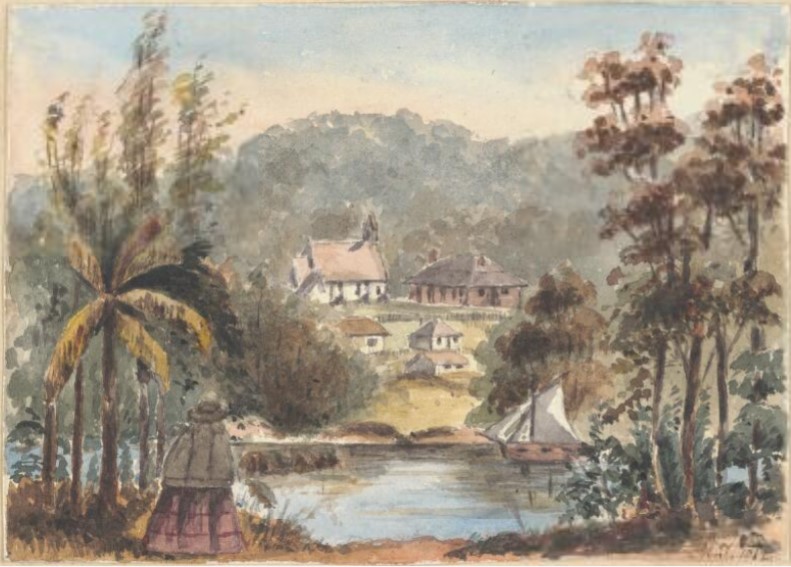
Churches. During the convict period, prisoners were mustered on Sundays and had Divine Service read to them whether they liked it or not. Moreton Bay briefly enjoyed the services of a Reverend Vincent, but he only stayed several months, returning to Sydney after suffering a bad case of Commandant Logan. Once free settlement began, housesContinue reading “The A-Z of Old Brisbane – some “C” stories.”
 Moreton Bay and More