
With, of course, a degree artistic licence… I find the date ascribed to this scene to be about ten years too early. Soldiers’ wives aside, I don’t think there were any ladies visiting the post office three years before free settlement. In fact, everything was taken care of by the military, who used steamers and brigsContinue reading “A Vanished World, in colour.”
Author Archives: Karen B
Amateur historian and writer.
An old offender at 14
The life of James Duffy is baffling to the modern reader. He is recorded in the Entry Book of the Industrial and Reformatory School Brisbane on April 27, 1871. His height and weight were not recorded, but he was described as being of fair complexion, with grey eyes and black hair. His father was Mr TContinue reading “An old offender at 14”
Work and Business in the 1860s and 1870s
Separation from New South Wales, exploration and the gold rushes of the 1860s had opened up Queensland. Towns were proclaimed, from the tropical north to the far west, and businesses and infrastructure followed. Railways would gradually cross the colony, replacing the bullock teams and carts that slowly dragged goods across rough bush tracks and over creeks.Continue reading “Work and Business in the 1860s and 1870s”
Leisure in the 1860s and 1870s
As the decade began, more people had access to cameras, and set about recording their daily lives with a passion. Of course, the middle and upper classes had more access to both leisure and photography, so much of the activity recorded here is of a class of people who could afford to record their activities.Continue reading “Leisure in the 1860s and 1870s”
Haunting images and odd details in 19th century photographs
The first photo is haunting. It is called “The Gold Escort” and features the first two Police officers killed on active duty in Queensland, and their murderer, Gold Commissioner Thomas Griffin. The people in the photograph are (seated, left to to right: Sergeant James Julian, Constable Patrick William Cahill, Constable John Francis Power, Gold CommissionerContinue reading “Haunting images and odd details in 19th century photographs”
How we lived and worked – 1859-1865
Separation from New South Wales occurred in 1859, and the new Colony of Queensland was proclaimed. It was a time of rapid social and economic change, and intrepid photography enthusiasts set about capturing and preserving daily life with an authenticity never seen before. Go west! Goondiwindi, on the border with New South Wales, was whereContinue reading “How we lived and worked – 1859-1865”
The Great Fire of Brisbane, 1864
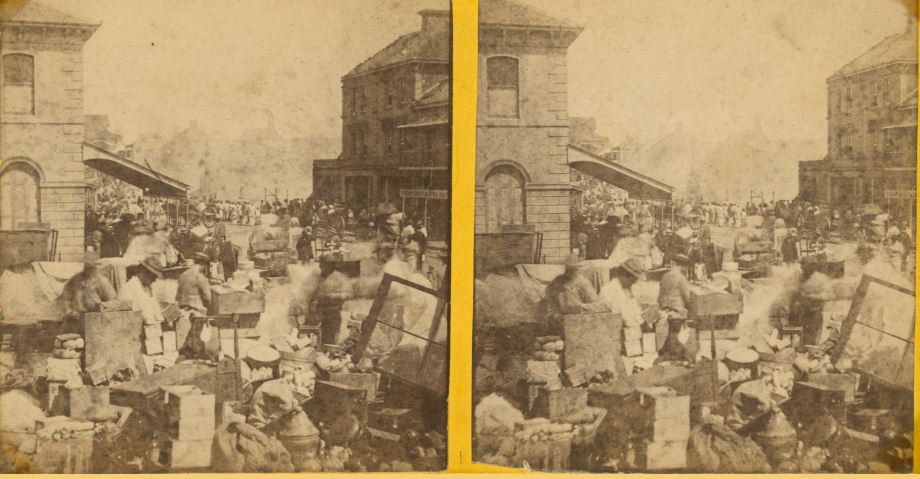
1864 was a turbulent year for Brisbane Town. Residents had barely recovered from catastrophic flooding, when, on 11 April, fire roared up Queen Street, destroying homes and businesses in its path. There were photographers and journalists on hand, many of whom lived “over the shop,” and the accounts and pictures are striking. Before the fireContinue reading “The Great Fire of Brisbane, 1864”
Christmas at Moreton Bay: from the Convict Era to Separation
CHRISTMAS IN THE CONVICT ERA. Christmas 1828 occurred on a Thursday, and the indefatigable Peter Spicer did not record it in his diary (Return of Works Performed), however the entry for Friday 26 December 1828 records: Perhaps not feeling what little Christmas spirit was to be had in the settlement were the 131 patients inContinue reading “Christmas at Moreton Bay: from the Convict Era to Separation”
A snapshot of life in Brisbane in 1866.
You can learn a great deal about life in a particular time and place from the daily newspapers, particularly the classified advertising. Here is a snapshot of life in Brisbane on 27 June 1866, courtesy of the Brisbane Courier. A suitable residence. This advertisement is designed to appeal to those who require a des resContinue reading “A snapshot of life in Brisbane in 1866.”
The Wild Scotchman’s Life after Crime
James Alpin McPherson’s criminal career came to an end at Gin Gin on 30 March 1866, when a group of local men recognised him and arranged an impromptu posse. They had the advantage of being better horsemen and shots than the police. The Maryborough Chronicle described his capture: “A man answering to his description hadContinue reading “The Wild Scotchman’s Life after Crime”
 Moreton Bay and More