
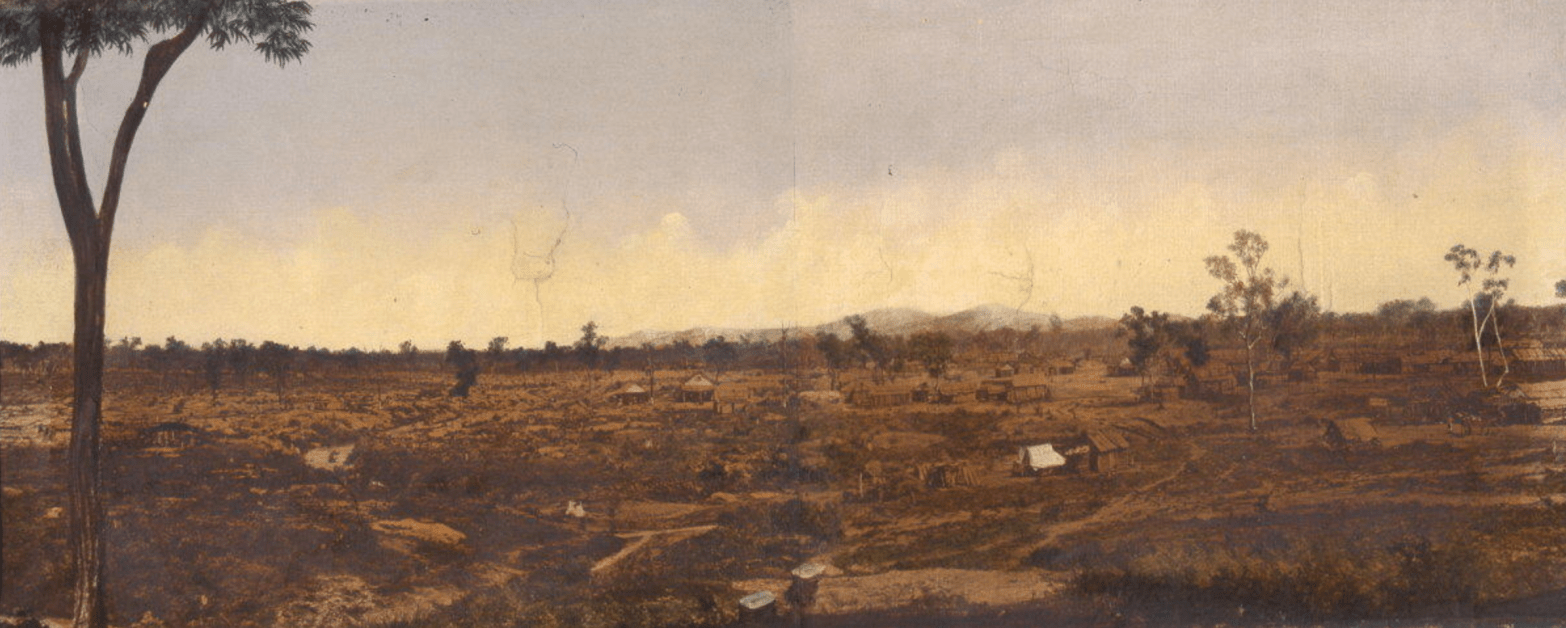
Richard Daintree worked as a geological surveyor in 1870, travelling the vast colony of Queensland on horseback. He collected samples of minerals, noted areas of interest, and took photographs. He travelled with his camera equipment in a little wooden case, recording the extraordinary scenery, and the people working tirelessly to make a living in harsh,Continue reading “The Working Day on the Goldfields – Richard Daintree Photos.”
Tag Archives: Goldfields
The Goldfields Riot – January 7, 1867
On the afternoon and evening of Monday 7 January 1867, a group of Europeans, estimated to be between 200 and 500 in number, terrorised the Chinese population at the Crocodile Creek gold diggings. When the mob was finished, many were injured, and just about every Chinese person in the township had lost everything but theContinue reading “The Goldfields Riot – January 7, 1867”
How NOT to Win Friends and Influence People in Colonial Queensland – Part 3.
Dr. Frederick Cumming in the 1860s. Henceforth, apart from one (disastrous, of course) toe-dip in the politics of West Moreton in 1867, Dr. Cumming would be known for his medical practice. There would be controversy, financial problems and some rather questionable verse. His experience of Brisbane in the 1860s would culminate in his return toContinue reading “How NOT to Win Friends and Influence People in Colonial Queensland – Part 3.”
Richard Daintree’s Queensland
Richard Daintree (1831-1878) was a geologist and photographer who worked on the Victorian Goldfields after graduating from Cambridge University. In 1865, Daintree moved to North Queensland and began recording his observations, leading to an appointment as Government Geologist for the region. His Victorian works are justly celebrated, but he also managed to capture the earliestContinue reading “Richard Daintree’s Queensland”
Richard Daintree Photographs
Englishman Richard Daintree joined the Victorian gold rush in the 1850s. He had no success in prospecting, but became a geologist, surveyor and photographer. Here are some of his photos of outback Queensland in the 1860s. Gold prospecting was a long, hard, often fruitless slog. Daintree’s photographs of the area, and the characters who workedContinue reading “Richard Daintree Photographs”
The Chinese Question in Queensland.
1850 – 1860: The answer to our economic prayers. In 1850, Moreton Bay looked forward to the arrival of 108 Chinese labourers, brought in by the ship, Favourite. All had been indentured to employers prior to landing, and competition for their services had been fierce. More Chinese workers were promised. We could hardly wait. TheyContinue reading “The Chinese Question in Queensland.”
Work and Business in the 1860s and 1870s
Separation from New South Wales, exploration and the gold rushes of the 1860s had opened up Queensland. Towns were proclaimed, from the tropical north to the far west, and businesses and infrastructure followed. Railways would gradually cross the colony, replacing the bullock teams and carts that slowly dragged goods across rough bush tracks and over creeks.Continue reading “Work and Business in the 1860s and 1870s”
How we lived and worked – 1859-1865
Separation from New South Wales occurred in 1859, and the new Colony of Queensland was proclaimed. It was a time of rapid social and economic change, and intrepid photography enthusiasts set about capturing and preserving daily life with an authenticity never seen before. Go west! Goondiwindi, on the border with New South Wales, was whereContinue reading “How we lived and worked – 1859-1865”
A Brief History of Bushranging in Queensland. Part 2.
Free Settlement to Separation to the Gold Rushes of the North. Bushranging – once the term used to describe escaped convicts – gradually came to mean armed robbery and a life spent on the roads, dodging the law. In the 1820s and 1830s in New South Wales and Tasmania, men like Jack Donohue “The WildContinue reading “A Brief History of Bushranging in Queensland. Part 2.”
Bushrangers on the goldfields – August 31 1868
On 31 August 1868, a man named – in the doubtful 19th century translation of Chinese names – Ah King Gun Woo, was returning to Bowen from the Cape River Goldfields with about 360 pounds in gold and notes and two silver watches. He was accosted by three armed bushrangers, who had blackened their facesContinue reading “Bushrangers on the goldfields – August 31 1868”
 Moreton Bay and More